
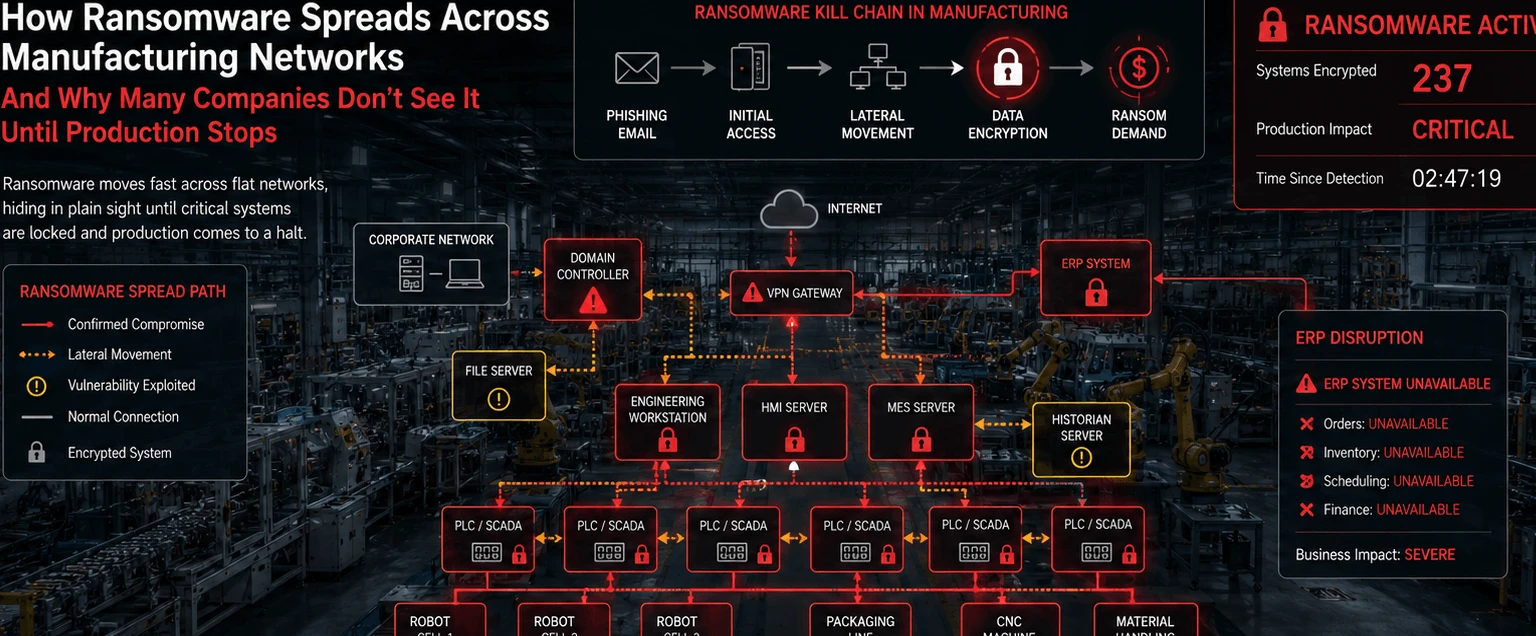
Ransomware attacks can spread across manufacturing environments in minutes or hours, often moving from a single compromised device to ERP systems, shared production files, backup repositories, and operational infrastructure before anyone realizes production is at risk. For manufacturers with 20–100 employees, even one ransomware incident can trigger multi-day operational disruption, delayed shipments, idle labor, lost production output, and recovery costs exceeding tens or hundreds of thousands of dollars.
Many manufacturers mistakenly believe ransomware only affects office computers. In reality, modern attacks increasingly target interconnected manufacturing environments where production systems, inventory platforms, engineering files, and operational networks are tightly connected. Without proper segmentation, cybersecurity controls, and recovery planning, a single phishing email or compromised remote connection can quickly spread across the entire operation.
The 5 Most Common Ways Ransomware Spreads Across Manufacturing Environments
Manufacturing environments are especially vulnerable because production systems, business systems, and operational infrastructure are often interconnected without adequate security separation.
1.Flat Networks Allow Ransomware to Move Freely
Many SMB manufacturers operate “flat” networks where office computers, production systems, ERP servers, warehouse systems, engineering workstations, and Wi-Fi devices all communicate within the same environment.
This allows ransomware to spread laterally across systems with minimal resistance.
One infected workstation can quickly affect production scheduling, shared files, and operational infrastructure.
2.Remote Access Systems Become Entry Points
Manufacturers increasingly rely on remote vendors, offsite IT support, hybrid work access, and remote production monitoring.
Without proper protections, remote access systems become major attack vectors. Common weaknesses include:
- weak passwords
- shared accounts
- missing MFA
- exposed RDP services
- outdated VPN appliances
Many ransomware attacks begin through compromised remote access credentials.
3.Shared File Systems Accelerate Infection
Manufacturing environments rely heavily on shared access to:
- CAD files
- production schedules
- ERP exports
- inventory spreadsheets
- quality documentation
- machine configurations
Once ransomware reaches shared storage, operational disruption accelerates rapidly.
This is especially dangerous for furniture manufacturers using shared CNC files, textile mills storing production specifications, plastics manufacturers managing tooling documentation, and beverage manufacturers maintaining batch records.
Shared production data often becomes one of the first operational casualties during ransomware incidents.
4.Legacy Systems Create Hidden Security Gaps
Many manufacturing environments continue operating unsupported operating systems, aging production computers, outdated firewalls, legacy production applications, and unpatched network devices.
These systems often cannot support modern security tools, remain exposed to known vulnerabilities, and create blind spots attackers exploit.
Legacy infrastructure frequently allows ransomware to spread undetected.
5.Backups and Production Systems Are Too Closely Connected
Many manufacturers unknowingly expose backup systems by keeping them:
- permanently connected
- accessible from production networks
- managed with shared credentials
- unsegmented from operational systems
Modern ransomware increasingly targets backup appliances, storage repositories, recovery systems before encryption begins.
Many companies discover backup exposure only after both production systems and backups are compromised.
What Happens After Ransomware Reaches Production Systems?
Once ransomware spreads into manufacturing operations, the impact often extends far beyond encrypted office files.
Operational Consequences
- Production Scheduling Breakdowns – Manufacturers may lose access to:
- ERP systems
- production schedules
- inventory coordination
- warehouse synchronization
-
- This quickly disrupts throughput and delivery timelines.
- Shipping and Fulfillment Delays – Ransomware often affects barcode systems, shipping software, warehouse coordination, and inventory tracking.
- Delayed shipments can continue long after systems are restored.
- Idle Labor and Overtime Costs – Employees may wait for systems to recover, shift to manual workarounds, re-enter production data, and work overtime to recover schedules.
- Engineering and Quality Data Loss – Manufacturers may lose access to CAD files, production recipes, machine settings, quality documentation, and traceability records.
- This creates major operational and compliance risk.
- Customer and Revenue Impact – Extended ransomware recovery can lead to missed contractual obligations, customer dissatisfaction, reduced production capacity, and reputational damage.
Many manufacturers underestimate how quickly ransomware becomes an operational crisis.
Why Manufacturing Companies Are Prime Ransomware Targets
Manufacturing remains one of the most targeted industries because attackers know downtime pressure creates urgency.
Why Attackers Target Manufacturers
- Continuous Operations Dependence – Manufacturers cannot easily pause operations without:
- revenue loss
- shipping disruption
- labor inefficiency
- customer impact
- Legacy Operational Environments – Many manufacturing environments still contain:
- unsupported systems
- weak segmentation
- limited monitoring
- outdated cybersecurity controls
- Operational Urgency Increases Pressure – Attackers know manufacturers often face:
- production deadlines
- customer commitments
- supply chain pressure
- regulatory requirements
This urgency increases pressure to restore systems quickly.
- Limited Internal Cybersecurity Resources – Manufacturers with 20–100 employees often:
- lack dedicated security teams
- rely on reactive support
- postpone cybersecurity modernization
Attackers frequently exploit these operational gaps.
How Ransomware Spreads in Real Manufacturing Environments (Illustrative Examples)
Furniture Manufacturer
A phishing email compromises an employee workstation connected to shared production files.
Operational impact:
- CNC file access disrupted
- production scheduling interrupted
- engineering documents encrypted
Root cause:
- flat network architecture
- missing MFA
- unrestricted file permissions
Plastics Manufacturer
Attackers gain access through outdated remote access credentials.
Operational impact:
- ERP systems encrypted
- production planning unavailable
- inventory synchronization disrupted
Root cause:
- weak remote access controls
- no network segmentation
- outdated firewall infrastructure
Beverage Manufacturer
Ransomware spreads into operational systems connected to batch tracking and warehouse coordination.
Operational impact:
- bottling schedules delayed
- traceability workflows interrupted
- shipment coordination disrupted
Root cause:
- production systems connected directly to office environments
In many manufacturing environments, ransomware spreads operationally long before it becomes visible organizationally.
How Manufacturers Reduce Ransomware Spread
Manufacturers that successfully contain ransomware typically implement layered operational protections.
The 5-Layer Manufacturing Ransomware Containment Framework
1.Network Segmentation
Separate:
- office systems
- production networks
- guest Wi-Fi
- IoT devices
- backup environments
Segmentation helps contain ransomware movement.
2.Multi-Factor Authentication (MFA)
MFA should protect:
- remote access systems
- email accounts
- administrative accounts
- cloud platforms
3.Endpoint Detection and Response (EDR)
Modern monitoring tools help:
- detect abnormal behavior
- isolate compromised devices
- reduce lateral movement
4.Backup Isolation and Recovery Validation
Manufacturers should maintain:
- immutable backups
- segmented recovery systems
- tested recovery procedures
Recovery readiness matters as much as prevention.
5.Continuous Monitoring and Patch Management
Manufacturers should continuously monitor:
- firewalls
- servers
- remote access systems
- network devices
- production infrastructure
Regular patching reduces exposure to known vulnerabilities.
Warning Signs Manufacturers Should Not Ignore
Manufacturers should immediately investigate:
- Unusual file encryption activity
- Unauthorized remote logins
- Slow network performance
- Unexpected administrator account changes
- Backup failures or missing backup alerts
- Antivirus or security tools disabled unexpectedly
- Abnormal traffic between office and production systems
Many ransomware attacks generate warning signs before production systems are fully affected.
Illustrative Scenario: Ransomware Spreads Across a Manufacturing Network
A 70-employee plastics manufacturer in Los Angeles experienced a ransomware attack that began through a compromised remote access account.
Because office systems, ERP infrastructure, production scheduling, and file servers were connected within a flat network, the attack quickly spread across the environment.
Operational consequences included:
- ERP outage
- production scheduling disruption
- inaccessible tooling documentation
- warehouse coordination delays
- overtime labor recovery costs
The company also discovered:
- backups were insufficiently isolated
- MFA was not fully enforced
- monitoring visibility was limited
After implementing:
- segmented production networks
- MFA
- endpoint monitoring
- backup isolation
- proactive monitoring
The manufacturer significantly reduced future ransomware exposure and improved operational resilience.
Why Work With an IT Provider That Understands Manufacturing Cybersecurity
Manufacturers should work with IT providers that understand:
- operational downtime risk
- ransomware containment strategies
- production network segmentation
- ERP and operational dependencies
- cybersecurity protections for manufacturing environments
- business continuity planning
A manufacturing-focused cybersecurity strategy protects more than data—it protects production continuity and operational stability.
Trust Signals
Fothion supports manufacturing companies that require:
- cybersecurity-first operational environments
- ransomware containment strategies
- proactive infrastructure monitoring
- business continuity planning
- manufacturing-focused IT strategy
- operational resilience improvements
With over 20 years of experience (since 2001), Fothion helps manufacturers reduce cyber risk, improve operational uptime, and strengthen production continuity.
Get a Manufacturing Cybersecurity Risk Assessment (30 Minutes)
If you’re unsure how exposed your manufacturing environment may be to ransomware spread, the fastest next step is identifying operational and cybersecurity vulnerabilities.
Book a 30-minute call with Fothion and we’ll:
- review ransomware exposure risks
- identify operational vulnerabilities
- assess segmentation and backup protections
- evaluate remote access security
- outline practical ways to reduce operational disruption
Book here: https://fothion.com/schedule-a-phone-call/
FAQs (with answers):
1.Why are manufacturers common ransomware targets?
Manufacturers rely heavily on continuous production operations, making downtime extremely costly. Attackers exploit this urgency to pressure companies during ransomware incidents.
2.How does ransomware spread across manufacturing networks?
Ransomware often spreads through flat networks, compromised remote access systems, shared file environments, phishing attacks, and unpatched infrastructure.
3.What is network segmentation in manufacturing?
Network segmentation separates office systems, production systems, backups, and operational infrastructure to help contain ransomware spread and reduce operational risk.
4.Can ransomware affect production systems?
Yes. Ransomware can disrupt ERP systems, production scheduling platforms, engineering files, inventory systems, and operational workflows connected to manufacturing networks.
5.How can manufacturers reduce ransomware risk?
Manufacturers can reduce risk through MFA, network segmentation, endpoint monitoring, isolated backups, proactive patching, and continuous infrastructure monitoring.
6.Why are backups important during ransomware attacks?
Backups help manufacturers recover operations without relying solely on attackers. However, backups must be isolated, tested, and protected from ransomware exposure.