
Building an IT Budget for Your Accounting Firm

Many accounting firms build annual budgets around staffing, office operations, and business development but technology is often addressed only when equipment fails or unexpected cybersecurity issues arise.
A more effective approach is to treat IT as a strategic investment.
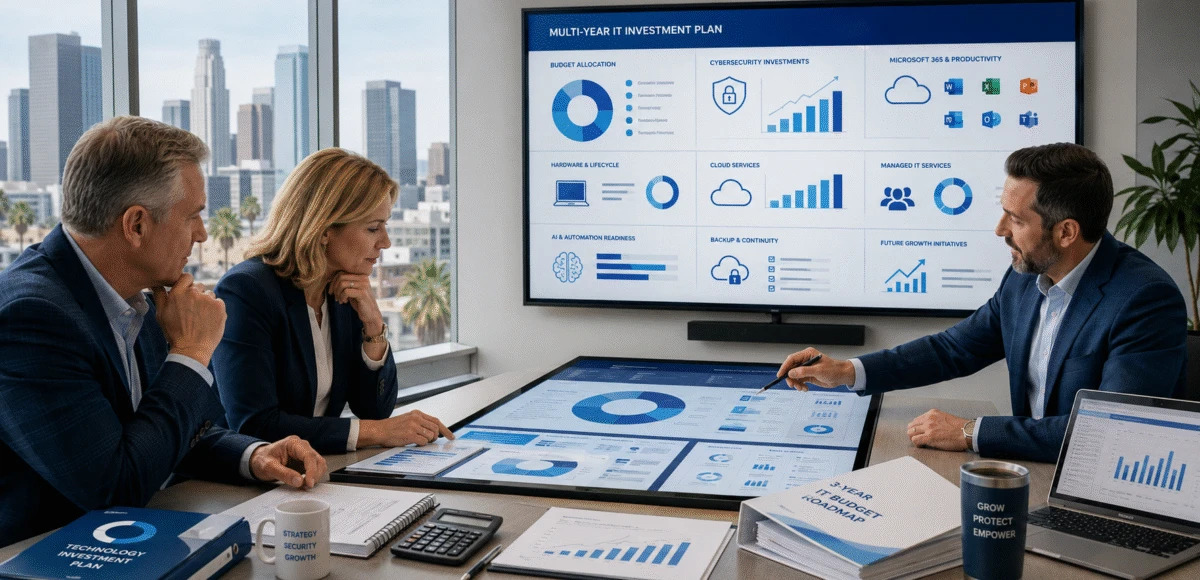
For accounting firms throughout Los Angeles County and Greater Los Angeles, a structured technology budget should include Managed IT Services, cybersecurity, Microsoft 365 licensing, hardware replacement, cloud services, business continuity planning, employee training, and future initiatives such as Artificial Intelligence (AI).
By planning these investments proactively, firms can reduce unexpected expenses, improve operational resilience, and align technology decisions with long-term business growth.
Why IT Budgeting Matters
Technology affects nearly every aspect of an accounting firm’s operations.
It supports:
- Client communications
- Tax and accounting software
- Microsoft 365
- Cybersecurity
- Remote work
- Secure document management
- Business continuity
- Artificial Intelligence
- Regulatory readiness
Without a structured budget, firms often make technology decisions reactively, replacing equipment only after failures occur or increasing cybersecurity spending only after a new threat emerges.
A strategic technology budget shifts planning from reactive spending to proactive investment.
Why This Matters
Technology is no longer a discretionary business expense.
It is essential infrastructure that supports client service, employee productivity, regulatory readiness, and long-term competitiveness.
The Seven Components of an Effective IT Budget
Rather than viewing technology as one line item, leadership should build a budget around the major categories that support daily operations and future growth.
Budget Category #1 — Managed IT Services
For many accounting firms, Managed IT Services represent the foundation of the annual technology budget.
Typical services include:
- Help desk support
- Cybersecurity monitoring
- Microsoft 365 administration
- Network management
- Backup monitoring
- Strategic planning
- Vendor management
- Technology reporting
Leadership should evaluate Managed IT Services based on business outcomes rather than monthly fees alone.
Executive Planning Tip
The lowest monthly IT cost is not always the lowest long-term business cost. Consider service quality, cybersecurity capabilities, strategic guidance, and operational resilience when evaluating providers.
Decision Table
| Budget Question | Strategic Approach | Reactive Approach |
|---|---|---|
| Managed IT Services | Planned annual investment | Selected based on lowest monthly fee |
| Technology projects | Included in roadmap | Funded only when necessary |
| Cybersecurity | Ongoing investment | Increased after incidents |
| Hardware | Scheduled replacement cycle | Replace only after failure |
Budget Category #2 — Cybersecurity
Cybersecurity should be treated as an ongoing operational investment rather than an occasional technology purchase.
Budget considerations may include:
- Endpoint Detection and Response (EDR)
- Microsoft Defender
- Multi-Factor Authentication (MFA)
- Security awareness training
- Vulnerability assessments
- Cybersecurity monitoring
- Incident response planning
- Cyber insurance readiness
Key Insight
Strong cybersecurity budgeting reduces the likelihood of costly business disruptions while supporting client trust and regulatory expectations.
Budget Category #3 — Microsoft 365 and Cloud Services
Microsoft 365 is one of the most important recurring technology investments for modern accounting firms.
Beyond licensing, leadership should budget for:
- Microsoft 365 Business Premium or Enterprise licensing
- Microsoft Defender
- Exchange Online
- SharePoint
- OneDrive
- Microsoft Teams
- Conditional Access
- Identity protection
- License optimization
- Ongoing administration
Cloud services should be reviewed annually to ensure licensing, security features, and usage align with current business needs.
Why This Matters
Microsoft 365 is no longer just an email platform. It supports collaboration, document management, cybersecurity, and increasingly, AI-powered productivity across the firm.
Budget Category #4 — Hardware Lifecycle Planning
Unexpected hardware failures often create unexpected budget problems.
Rather than replacing equipment only after it fails, accounting firms should establish scheduled replacement cycles.
Technology commonly included in lifecycle planning:
- Employee laptops
- Desktop computers
- Servers (where applicable)
- Firewalls
- Wireless networking equipment
- Conference room technology
- Monitors and docking stations
Many firms budget hardware replacements over a three- to five-year lifecycle, helping spread costs more predictably over time.
Executive Planning Tip
Budgeting for planned hardware refreshes is generally less expensive than responding to emergency equipment failures during tax season or other critical business periods.
Budget Category #5 — Business Continuity and Disaster Recovery
Business continuity should be treated as an operational investment rather than an emergency expense.
Budget considerations include:
- Backup solutions
- Backup monitoring
- Restore testing
- Disaster recovery planning
- Business continuity exercises
- Internet redundancy
- Secure remote access
- Recovery planning
Leadership should evaluate these investments based on their ability to reduce operational downtime rather than their individual technology costs.
Decision Table
| Business Goal | Technology Investment |
|---|---|
| Reduce downtime | Business continuity planning |
| Protect client information | Secure backups and recovery |
| Maintain productivity | Disaster recovery readiness |
| Improve resilience | Regular testing and documentation |
Budget Category #6 — AI and Innovation
Artificial Intelligence is becoming an increasingly important component of technology planning.
Rather than creating a separate “AI budget,” firms should integrate AI into their broader technology strategy.
Potential investments include:
- Microsoft Copilot licensing
- AI governance initiatives
- Employee AI training
- Process automation
- Secure AI platforms
- AI readiness assessments
- Policy development
- Productivity improvements
AI investments should always be accompanied by governance, cybersecurity, and employee education.
Why This Matters
Successful AI adoption depends as much on planning and governance as it does on software licensing.
Budget Category #7 — Strategic Projects and Future Growth
Not every technology investment fits neatly into a recurring monthly expense.
Leadership should reserve budget for strategic initiatives such as:
- Office expansions
- Cloud migrations
- New accounting software
- Security improvements
- Digital transformation projects
- Compliance initiatives
- Network upgrades
- Technology consulting
Including these projects in the annual planning process reduces the likelihood of unplanned capital requests later in the year.
Sample Annual Technology Budget Framework
The following example illustrates how accounting firms often organize annual technology planning.
| Budget Category | Planning Focus |
|---|---|
| Managed IT Services | Ongoing operational support |
| Cybersecurity | Continuous protection and monitoring |
| Microsoft 365 | Licensing, administration, security |
| Hardware | Scheduled lifecycle replacement |
| Business Continuity | Backup and disaster recovery |
| AI Initiatives | Governance, training, productivity |
| Strategic Projects | Growth, modernization, innovation |
This framework encourages leadership to evaluate technology investments holistically rather than as isolated expenses.
Three-Year Technology Investment Roadmap
Many accounting firms benefit from planning technology investments across multiple years.
| Timeframe | Planning Priorities |
|---|---|
| Year 1 | Strengthen cybersecurity, optimize Managed IT Services, review Microsoft 365, establish hardware lifecycle plan |
| Year 2 | Expand business continuity capabilities, modernize infrastructure, implement AI governance, improve executive reporting |
| Year 3 | Accelerate AI adoption, optimize automation, replace aging infrastructure, support business expansion |
A multi-year roadmap helps leadership align technology investments with firm growth rather than reacting to immediate operational needs.
Executive Budget Planning Checklist
Review this checklist during your annual budgeting process.
Operations
☐ Managed IT Services reviewed.
☐ Microsoft 365 licensing evaluated.
☐ Vendor contracts reviewed.
☐ Support requirements forecasted.
Security
☐ Cybersecurity investments planned.
☐ Security assessments scheduled.
☐ Employee awareness training budgeted.
☐ Cyber insurance requirements reviewed.
Infrastructure
☐ Hardware lifecycle updated.
☐ Network equipment reviewed.
☐ Backup strategy funded.
☐ Business continuity improvements planned.
Future Growth
☐ AI initiatives evaluated.
☐ Technology roadmap updated.
☐ Strategic projects prioritized.
☐ Budget reviewed with executive leadership.
Common IT Budgeting Mistakes
Many accounting firms unintentionally create budget challenges through reactive planning.
Common mistakes include:
- Budgeting Only for Monthly Support
- Recurring support is important, but it represents only one portion of the overall technology investment.
- Ignoring Hardware Replacement
- Delaying workstation, firewall, or networking upgrades often results in larger emergency expenses later.
- Treating Cybersecurity as a One-Time Project
- Cybersecurity requires continuous investment in monitoring, training, assessments, and technology improvements.
- Excluding Strategic Projects
- Cloud migrations, AI initiatives, and infrastructure modernization should be anticipated rather than treated as unexpected expenses.
- Separating Technology from Business Planning
- Technology budgeting should directly support the firm’s strategic objectives, client experience, operational resilience, and long-term growth.
Cost Planning Considerations
Technology budgets vary according to firm size, operational complexity, regulatory expectations, and growth plans.
For accounting firms with 20–100 employees, annual budgets often include a combination of:
- Managed IT Services
- Microsoft 365 licensing
- Cybersecurity investments
- Hardware lifecycle replacements
- Business continuity planning
- Strategic consulting
- AI initiatives
- Technology projects
The emphasis should remain on building a predictable, sustainable investment plan rather than minimizing short-term spending.
“The most effective IT budgets are not built around technology purchases. They are built around the capabilities your accounting firm needs to serve clients securely, efficiently, and profitably.”
Why IT Budget Planning Matters in Los Angeles
Accounting firms throughout Los Angeles County and Greater Los Angeles face increasing expectations related to cybersecurity, client service, Microsoft 365, AI adoption, and operational resilience.
A structured technology budget helps leadership anticipate these needs, reduce financial surprises, and ensure that technology investments support the firm’s long-term strategy rather than simply addressing short-term operational issues.
By integrating Managed IT Services, cybersecurity, business continuity, cloud services, and innovation into a single planning process, firms can make more informed financial decisions while strengthening their competitive position.
Real-World Planning Scenario
How a Los Angeles Accounting Firm Replaced Reactive IT Spending with a Three-Year Technology Budget
A 55-person accounting firm in Los Angeles County had historically managed technology spending on an as-needed basis.
When laptops failed, they were replaced.
When a server reached capacity, it was upgraded.
When cybersecurity threats increased, additional security tools were purchased.
Although these decisions solved immediate problems, leadership found annual budgeting increasingly difficult because technology expenses were unpredictable.
During a strategic planning session, the firm worked with its Managed IT Services Provider to create a three-year technology roadmap tied directly to its annual budget.
The roadmap identified:
- Scheduled workstation replacements.
- Microsoft 365 licensing requirements.
- Planned cybersecurity improvements.
- Backup and disaster recovery investments.
- AI readiness initiatives.
- Future office expansion requirements.
- Network infrastructure upgrades.
Instead of reacting to unexpected expenses, leadership could now forecast upcoming investments, prioritize projects according to business impact, and spread costs across multiple budget cycles.
The result was greater financial predictability, fewer emergency technology purchases, and improved alignment between technology investments and business goals.
Rather than viewing IT as an unpredictable expense, leadership began treating it as a planned investment that supported long-term growth.
Executive Decision Framework
Use the following framework to evaluate your firm’s current IT budgeting process.
If Technology Spending Is Mostly Reactive
Begin by establishing a structured annual technology planning process.
Recommended priorities include:
- Inventory technology assets.
- Review hardware lifecycle.
- Assess cybersecurity maturity.
- Evaluate Managed IT Services.
- Develop a three-year technology roadmap.
If Your Firm Already Has an Annual IT Budget
Expand planning beyond recurring operational expenses.
Consider budgeting for:
- Strategic technology projects.
- AI initiatives.
- Business continuity improvements.
- Microsoft 365 optimization.
- Executive reporting enhancements.
- Security assessments.
If Your Firm Is Growing
Growth often introduces new technology costs.
Review:
- New employee onboarding.
- Microsoft 365 licensing.
- Office expansion.
- Additional cybersecurity requirements.
- Internet and networking capacity.
- Cloud infrastructure.
- AI adoption.
Planning for growth helps reduce unexpected budget requests throughout the year.
If Your Technology Planning Is Mature
Shift from annual budgeting to continuous financial planning.
Leadership should review:
- Quarterly budget performance.
- Technology roadmap progress.
- Hardware replacement forecasts.
- Cybersecurity investments.
- Vendor agreements.
- AI strategy.
- Business priorities.
Boardroom Questions Every Managing Partner Should Ask
Technology budgets should support business strategy and not simply maintain existing systems.
During your next budget planning meeting, consider asking:
- Does our technology budget support our firm’s three-year business plan?
- Which technology investments will reduce business risk the most?
- Are we replacing hardware proactively or only after failures?
- Are cybersecurity investments keeping pace with emerging threats?
- Have we budgeted for Microsoft 365 improvements and AI initiatives?
- Are we receiving sufficient strategic guidance from our IT provider?
- Which technology projects should be prioritized next year?
- If we grow by 20%, will our technology budget support that growth?
These questions help leadership ensure technology investments remain aligned with operational priorities and long-term business objectives.
Conclusion
Technology budgeting should never be limited to replacing hardware or paying monthly service invoices.
For accounting firms throughout Los Angeles County and Greater Los Angeles, a well-planned IT budget supports cybersecurity, Microsoft 365, business continuity, AI adoption, operational resilience, and long-term growth.
When technology investments are aligned with a strategic roadmap, leadership can make informed financial decisions, reduce unexpected expenses, and ensure the firm’s technology continues supporting its business objectives.
The most successful accounting firms do not ask, “How can we spend less on technology?”
Instead, they ask:
“How can we invest in technology that strengthens our business for the future?”
Is your accounting firm’s technology budget preparing you for next year or the next five years?
Fothion helps accounting firms throughout Los Angeles County and Greater Los Angeles develop strategic technology budgets that align Managed IT Services, cybersecurity, Microsoft 365, AI initiatives, hardware lifecycle planning, and business continuity with long-term business goals.
A technology budgeting and roadmap workshop can help your leadership team prioritize investments, improve financial predictability, and support sustainable growth.
Book a 30-minute call with Fothion: https://www.fothion.com/schedule-a-phone-call/
- Frequently Asked Questions
- How much should an accounting firm budget for IT?
- There is no universal budget because technology spending varies based on firm size, infrastructure, cybersecurity requirements, cloud adoption, and growth plans. Rather than targeting a fixed percentage, firms should align technology investments with business priorities and long-term operational needs.
- Should cybersecurity have its own budget?
- Yes. Cybersecurity should be planned as an ongoing operational investment that includes monitoring, employee awareness training, security assessments, Microsoft 365 security, endpoint protection, and business continuity planning.
- How often should we review our IT budget?
- Most accounting firms should review technology budgets annually as part of the budgeting process while monitoring progress through quarterly technology and financial reviews.
- Should hardware replacements be planned years in advance?
- Yes. A three- to five-year hardware lifecycle helps reduce unexpected expenses and allows leadership to schedule replacements before aging equipment begins affecting productivity or security.
- Should AI be included in our technology budget?
- Yes. AI initiatives, including governance, employee training, licensing, automation, and policy development, should be incorporated into long-term technology planning rather than treated as isolated projects.
- Can Managed IT Services help control technology costs?
- Many accounting firms find that Managed IT Services improve cost predictability through proactive maintenance, strategic planning, cybersecurity management, and scheduled technology lifecycle planning.
- How does an IT roadmap improve budgeting?
- A technology roadmap identifies future investments before they become urgent, allowing leadership to spread costs across multiple years while aligning projects with business goals.
- Can a Managed IT Services Provider help build our technology budget?
- Yes. Strategic Managed IT Services Providers often assist with budgeting, technology roadmaps, hardware lifecycle planning, cybersecurity investment strategies, Microsoft 365 optimization, and Quarterly Business Reviews.
Leave a Comment