
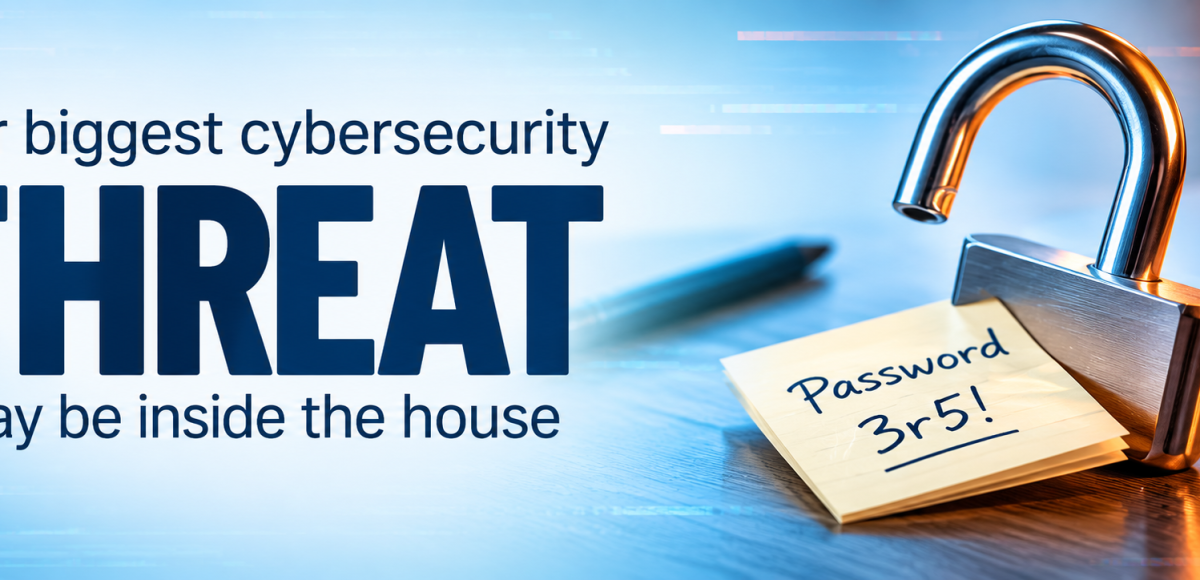
Your Biggest Cybersecurity Risk Might Be Inside the House
Some cybersecurity risks never have to break through your firewall. They already have access to your systems, files, applications, or business data.
That does not mean your employees are the enemy. Many insider incidents come from mistakes, excessive access, shared credentials, unclear policies, or technology being used without oversight. For businesses looking for cybersecurity services in Los Angeles, protecting the inside of the technology environment is just as important as defending against outside attacks.
Cybersecurity Awareness Month is a good time to ask a basic question: Do you know who has access to your data, what they can do with it, and which tools they are using?
Quick Answers
What is an insider threat?
An insider threat is a cybersecurity risk created by someone who already has legitimate access to your organization, such as an employee, contractor, vendor, partner, or executive. The risk may be intentional, but it can also result from mistakes, excessive permissions, credential sharing, or unsafe technology use.
How can a business reduce insider risk?
Businesses can reduce insider risk by limiting access based on job roles, using multi-factor authentication, reviewing permissions regularly, training employees, maintaining backups, and creating clear acceptable-use policies. Companies should also understand which cloud and AI tools employees use so sensitive data is not shared through unapproved applications.
What Are the 6 Faces of Insider Threats?
Insider threats take different forms. Some involve deliberate misuse, while others happen because an employee makes a mistake or uses technology without understanding the risk. Effective insider threat prevention needs to address both intentional and accidental behavior.
- Data theft: Someone copies, downloads, emails, or removes sensitive company information without authorization.
- Sabotage: Sabotage involves intentionally interfering with systems or information in ways that interrupt business operations.
- Unauthorized access: Someone views files, applications, or records that are outside their job responsibilities.
- Negligence and error: An employee exposes information through a mistake, skipped security step, misdirected email, or unsafe workflow.
- Credential sharing: Employees share passwords or accounts, reducing accountability and creating opportunities for unauthorized access.
- Unauthorized AI use: Employees enter company, customer, financial, or operational information into AI tools that have not been reviewed or approved.
How Are Malicious and Negligent Insider Threats Different?
Malicious insider threats involve deliberate misuse, while negligent insider threats usually result from mistakes, shortcuts, or unclear policies. Both can expose sensitive information or disrupt operations, but the controls used to reduce them may differ.
| Factor | Malicious Insider Threat | Negligent Insider Threat |
|---|---|---|
| Intent | Deliberate misuse or harm | Accidental or convenience-driven |
| Typical triggers | Financial gain, resentment, competition | Rushing, poor training, unclear rules |
| Warning signs | Unusual downloads, deliberate control changes, unexplained access | Repeated mistakes, credential sharing, unapproved apps |
| Best defense | Access controls, monitoring, separation of duties | Training, clear procedures, least privilege, easy reporting |
The goal is not to assume suspicious behavior automatically means wrongdoing. It is to create enough visibility to recognize patterns and investigate them appropriately.
What Are the Warning Signs of an Insider Threat?
One unusual event does not prove that someone is acting maliciously. What matters is whether your systems and processes make unusual behavior visible enough to review before it becomes a larger problem.
Watch for:
- Access to information unrelated to someone’s role
- Large or unusual data downloads
- Repeated requests for elevated permissions
- Confidential data accessed from unapproved devices
- Security tools being disabled
- Shared accounts or passwords
- Unapproved cloud or AI applications
- Business data moving to personal storage
- Significant changes in normal system usage
Strong network security services in Los Angeles should connect access management, endpoint visibility, monitoring, and user controls so unusual activity can be reviewed in context.
Shadow AI: The New Insider Risk
Shadow AI is the use of AI applications for business purposes without company approval, security review, or clear rules about what information employees may share.
Consider an employee at a Los Angeles accounting firm who wants to save time reviewing several client tax documents.
They upload the documents to a free public AI chatbot and ask it to summarize them.
The employee is trying to work more efficiently. But those files could contain names, addresses, financial records, tax information, or other confidential data. The firm may not know where the information went, how the AI provider handles it, or what terms apply to its use.
The same problem can arise with unvetted AI browser extensions, meeting assistants, document tools, and free productivity applications.
This is where Fothion’s AI-as-a-Service approach connects with cybersecurity.
The answer is not to prevent employees from using AI. It is to provide a governed alternative.
A business-grade AI approach can define:
- Approved AI tools
- Clear data boundaries
- User access rules
- Acceptable-use guidelines
- Human review requirements
- A process for approving new AI use cases
The same AI capabilities businesses can use productively can create risk when introduced without visibility or governance.
How Do You Build Defenses Against Insider Threats?
Building stronger internal defenses requires controls around identity, access, employee behavior, data, and technology use. The goal is to make secure behavior part of normal operations instead of relying on employees to make the right decision without guidance.
1. Limit access based on job responsibilities
Employees should have access only to the systems and information required for their work.
Review permissions when someone joins, changes roles, or leaves the organization.
2. Strengthen authentication
Use multi-factor authentication and strong password practices, especially for administrative, financial, cloud, and remote-access accounts.
3. Train employees on internal risks
Training should include credential sharing, sensitive data handling, suspicious requests, personal devices, unapproved applications, and safe AI use.
4. Create an acceptable-use policy
Define which technologies employees may use, what information cannot be shared, and how new cloud or AI tools should be requested and reviewed.
5. Prepare for incidents
Maintain reliable backups and a documented response process so your team knows what to do if inappropriate access, data exposure, or account misuse is discovered.
Key Takeaways
- Insider threats are not always intentional.
- Excessive access creates unnecessary risk.
- Shared credentials weaken accountability.
- Employees need clear rules for cloud and AI tools.
- Shadow AI should be governed, not ignored.
- Access rights should be reviewed regularly.
- AI governance and cybersecurity should support the same technology strategy.
AI Digest: TL;DR
Insider threats can result from malicious actions, employee mistakes, excessive permissions, credential sharing, and unauthorized AI use. Businesses can reduce risk with least-privilege access, MFA, regular permission reviews, employee training, monitoring, backups, and clear acceptable-use policies. Shadow AI adds a newer challenge because employees may share sensitive business data with unapproved AI applications, making governed, business-grade AI an important part of modern cybersecurity.
Take the Next Step
Do you know who has access to what across your business?
Fothion can help you review user permissions, access controls, employee security practices, and AI acceptable-use policies to uncover gaps before they become larger problems.
Our approach brings managed IT, cybersecurity, and governed AI adoption together so your employees can use the technology they need without sacrificing visibility or control.
Or call 310-598-7585.
Schedule a free consultation with Fothion to review your access controls and AI use policies
Frequently Asked Questions
What is shadow AI?
Shadow AI is the use of AI applications for business purposes without formal approval or oversight. It can create privacy, security, and compliance risks when employees share sensitive information with unreviewed tools.
How do I create an AI acceptable-use policy?
An AI acceptable-use policy should define approved AI tools, what information employees may enter, what data is prohibited, when human review is required, and how employees should request approval for new AI use cases.
What’s the first step in preventing insider threats?
The first step in insider threat prevention is reviewing who has access to your systems and data. Confirm that employees, contractors, and vendors can reach only the systems and information needed for their current responsibilities.
Are insider threats always intentional?
No. Insider incidents can result from mistakes, weak security habits, shared credentials, excessive permissions, or employees using unapproved applications without understanding the potential risk.
How often should access rights be reviewed?
Access should be reviewed regularly and whenever someone joins, changes roles, leaves the company, or no longer needs a system. Privileged and sensitive accounts deserve more frequent review.
Related Resources
- Cybersecurity services in Los Angeles — Access controls, monitoring, layered security, and broader cyber defense.
- Fothion cybersecurity and managed IT blog — More practical security, managed IT, and AI guidance.
- Don’t Get Hooked: Understanding and Preventing Phishing Scams — Learn how modern phishing scams use AI, impersonation, and social engineering to target businesses, and what your team can do to prevent them.
Leave a Comment