
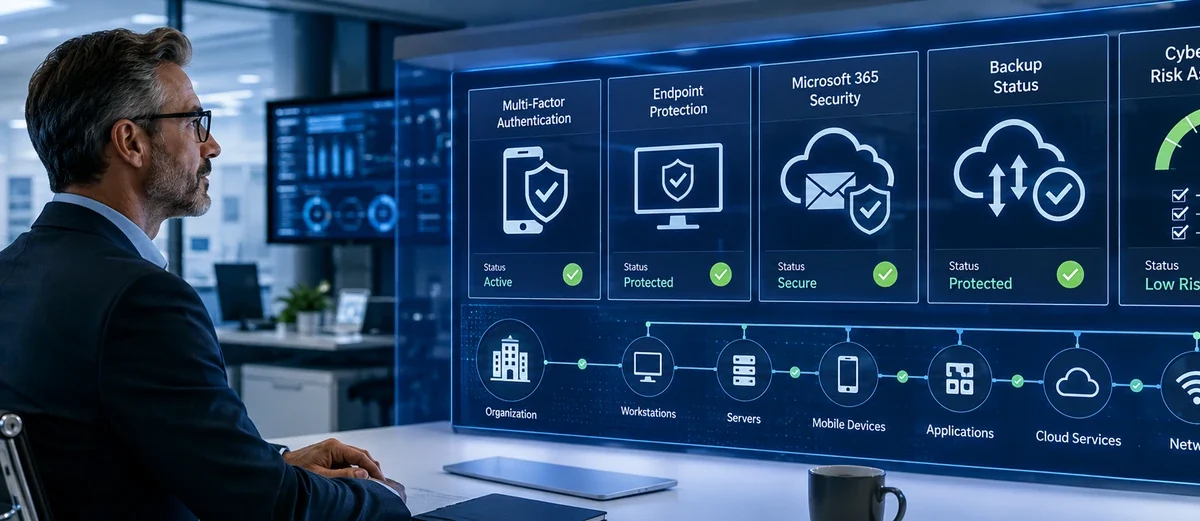
Healthcare Cybersecurity Checklist: Essential Security Controls Every Medical Practice Should Have
Cybersecurity is no longer just an IT concern. It’s also an issue for patient care, business continuity, and operational resilience. Every healthcare organization should implement layered security controls that include Multi-Factor Authentication (MFA), Endpoint Detection and Response (EDR), secure backups, employee security awareness training, identity and access management, email security, vulnerability management, and a documented Incident Response Plan. This checklist will help your medical or dental practice identify strengths, uncover potential gaps, and prioritize improvements that support both patient trust and regulatory responsibilities.
Who This Guide Is For
This guide is designed for:
- Physicians
- Medical Practice Owners
- Dental Practice Owners
- Practice Administrators
- Office Managers
- Healthcare CEOs
- Compliance Officers
- IT Managers
- Behavioral Health Providers
- Home Health Agencies
- Multi-location Healthcare Organizations
Whether your practice has 10 employees or 100, this checklist provides a practical framework for evaluating your cybersecurity posture and improving your organization’s ability to protect patient information.
Why Healthcare Organizations Continue to Be Prime Targets
Healthcare organizations manage some of the most valuable information cybercriminals can obtain.
Unlike a stolen credit card, which can often be canceled within hours, medical records may contain years of sensitive information, including:
- Patient demographics
- Medical histories
- Insurance information
- Billing records
- Prescription information
- Employment data
- Financial information
In addition to protecting patient privacy, healthcare organizations depend heavily on technology to deliver care.
A cybersecurity incident may affect:
- Electronic Health Records (EHR)
- Appointment scheduling
- Prescription systems
- Imaging platforms
- Billing operations
- Communication systems
- Telehealth services
- Clinical workflows
When technology becomes unavailable, patient care and business operations can be disrupted simultaneously.
Why This Matters to Your Practice
Cybersecurity isn’t simply about preventing hackers from accessing computers. It’s about helping physicians, clinical staff, and administrators continue delivering safe, efficient patient care while protecting the trust patients place in your organization.
Cybersecurity Is Built in Layers
One of the biggest misconceptions in healthcare is that purchasing a single cybersecurity product makes an organization “secure.”
It doesn’t.
Strong cybersecurity is built through multiple layers of protection, each designed to reduce risk if another safeguard fails.
For example:
If an employee clicks a phishing email…
- Email security may detect the message.
- Security awareness training may help the employee recognize the threat.
- Multi-Factor Authentication (MFA) may prevent stolen passwords from being used.
- Endpoint Detection and Response (EDR) may identify malicious activity.
- Network monitoring may detect unusual behavior.
- Secure backups may allow recovery if ransomware is deployed.
Each layer works together to improve resilience.
Healthcare organizations that rely on a single control create unnecessary risk.
What Is a Cybersecurity Checklist?
A cybersecurity checklist is a structured way to evaluate whether your organization has implemented the foundational controls needed to reduce cyber risk.
Rather than focusing on individual products, a checklist helps healthcare leaders answer questions such as:
- Have we implemented the most important security controls?
- Are our policies aligned with how employees actually work?
- Are we protecting patient information appropriately?
- Do we know how we would respond to a cyber incident?
- Are we continuously improving our security posture?
A checklist does not replace a formal Security Risk Assessment.
Instead, it provides a practical starting point for evaluating cybersecurity maturity and identifying areas that deserve further attention.
Expert Tip
The most effective cybersecurity programs don’t strive for perfection. They focus on continuous improvement by addressing the highest-priority risks first and strengthening security over time..
The Ten Core Security Controls Every Medical Practice Should Have
While every healthcare organization has different operational needs, several foundational controls should exist in nearly every environment.
These controls work together to reduce risk while supporting secure, reliable patient care.
1. Identity and Access Management
The first line of defense is controlling who can access your systems and what they can access.
Identity and Access Management (IAM) includes:
- Unique user accounts
- Role-based access
- Least-privilege permissions
- Regular access reviews
- Prompt removal of former employee accounts
- Secure identity management for cloud services
Strong identity management reduces the likelihood that compromised accounts can be used to access sensitive systems or patient information.
2. Multi-Factor Authentication (MFA)
Passwords alone are no longer sufficient.
Multi-Factor Authentication adds another layer of verification by requiring users to provide something they know (such as a password) and something they have (such as an authentication app or security key).
Healthcare organizations should prioritize MFA for:
- Microsoft 365
- Electronic Health Record systems (where supported)
- VPN and remote access
- Administrative accounts
- Cloud applications
- Financial and payroll systems
MFA is one of the most effective ways to reduce the impact of compromised credentials.
3. Endpoint Detection and Response (EDR)
Traditional antivirus software is no longer enough to defend against today’s cyber threats.
Endpoint Detection and Response (EDR) continuously monitors computers and servers for suspicious behavior that may indicate malware, ransomware, or unauthorized activity.
Modern EDR solutions can often:
- Detect unusual behavior
- Isolate compromised devices
- Alert security personnel
- Support incident investigations
- Help contain attacks before they spread
For healthcare organizations, rapid detection can significantly reduce operational disruption.
4. Email Security
Email remains one of the most common ways attackers gain access to healthcare organizations.
An effective email security strategy includes:
- Spam filtering
- Phishing protection
- Attachment scanning
- URL protection
- Email authentication technologies
- Employee phishing awareness training
Technology and employee awareness work best when implemented together.
5. Vulnerability & Patch Management
Cybercriminals frequently exploit known software vulnerabilities that organizations have not yet addressed.
A Vulnerability and Patch Management program helps reduce this risk by ensuring operating systems, applications, and connected devices receive security updates in a timely manner.
Healthcare organizations should establish documented processes for:
- Monitoring newly discovered vulnerabilities
- Prioritizing critical security updates
- Testing patches before deployment when appropriate
- Applying updates to operating systems
- Updating third-party software
- Reviewing firmware updates for network equipment
- Replacing unsupported or end-of-life software
While not every update requires immediate installation, delaying critical security patches without a documented reason can unnecessarily increase organizational risk.
Why This Matters to Your Practice
Many successful cyberattacks don’t rely on sophisticated hacking techniques. They exploit vulnerabilities that already have security updates available. Consistent patch management helps close those opportunities before attackers can take advantage of them.
6. Secure Backup & Disaster Recovery
Every healthcare organization should assume that, at some point, systems may become unavailable due to ransomware, hardware failure, natural disasters, or human error.
Backups are the safety net that helps organizations recover.
However, having backups is not the same as being able to recover.
A resilient backup strategy should include:
- Automated backups
- Encrypted backup storage
- Multiple backup copies
- Offline or immutable backups where appropriate
- Regular restoration testing
- Clearly defined Recovery Time Objectives (RTOs)
- Clearly defined Recovery Point Objectives (RPOs)
Leadership should understand how long recovery is expected to take and not discover those timelines during an emergency.
Questions Every Healthcare Organization Should Be Able to Answer
- When was the last successful backup?
- When was the last restoration test?
- How quickly can critical systems be restored?
- Which systems are restored first?
- Who is responsible for initiating recovery?
If these questions cannot be answered confidently, additional planning may be needed.
Expert Tip
A backup is only valuable if it can be restored successfully. Schedule periodic recovery exercises, not just backup verification, to confirm that your organization can recover critical systems within acceptable timeframes.
7. Security Awareness Training
Technology alone cannot prevent every cyber incident.
Employees remain one of the strongest and sometimes weakest security controls.
Effective security awareness training should help employees recognize:
- Phishing emails
- Business Email Compromise (BEC)
- Social engineering
- Password attacks
- AI-assisted scams
- SMS phishing (Smishing)
- Voice phishing (Vishing)
- Physical security concerns
Training should be practical rather than technical.
Employees should leave each session knowing:
- What suspicious activity looks like
- How to respond
- Who to contact
- Why reporting quickly matters
Security Awareness Should Be Ongoing
Annual compliance training is important, but cybersecurity awareness should continue throughout the year.
Consider reinforcing key topics through:
- Monthly security reminders
- Quarterly awareness campaigns
- Phishing simulations
- Short educational videos
- Team discussions
- Incident reviews
Frequent reinforcement helps security become part of everyday workplace culture.
8. Network Security
Your network serves as the foundation for nearly every technology used within your practice.
Strong network security helps protect:
- Electronic Health Records
- Medical devices
- Cloud applications
- Internet access
- Wireless networks
- Connected offices
- Remote users
Foundational network security measures typically include:
- Business-grade firewalls
- Secure wireless networks
- Network segmentation
- Secure DNS services
- Intrusion detection and monitoring
- Remote access protections
- Regular firewall rule reviews
Healthcare organizations should periodically review network architecture as clinical and business needs evolve.
9. Incident Response Planning
Even organizations with mature cybersecurity programs should prepare for the possibility of a security incident.
An Incident Response Plan helps leadership respond quickly and consistently.
A documented plan should identify:
- Incident response team members
- Internal communication procedures
- External contacts
- Escalation procedures
- Roles and responsibilities
- Decision-making authority
- Business continuity procedures
- Post-incident review process
Organizations that practice their Incident Response Plans through tabletop exercises are often better prepared than those relying solely on written documentation.
Why This Matters to Your Practice
During a cyber incident, uncertainty can become just as disruptive as the attack itself. A documented and rehearsed Incident Response Plan helps leadership make informed decisions while reducing confusion and protecting patient care.
10. Continuous Security Risk Assessments
Cybersecurity is never “finished.”
Technology changes.
Threats evolve.
Healthcare organizations grow.
A Security Risk Assessment provides leadership with a structured process for identifying, evaluating, and prioritizing cybersecurity risks.
An effective assessment should consider:
- Technology infrastructure
- User access
- Cloud services
- Medical devices
- Third-party vendors
- Policies and procedures
- Workforce practices
- Business continuity
- Regulatory expectations
Risk assessments should support informed decision-making and not simply satisfy compliance requirements.
Common Cybersecurity Gaps Healthcare Organizations Should Address
Many healthcare organizations have invested significantly in technology while unintentionally overlooking foundational security practices.
The following gaps are among the most common.
Gap #1: Shared User Accounts
Employees should have individual user accounts whenever possible.
Shared accounts reduce accountability and make incident investigations more difficult.
Gap #2: Inactive User Accounts
Former employees, contractors, or temporary staff should not retain unnecessary system access.
Regular access reviews help reduce this risk.
Gap #3: Unsupported Software
Older operating systems and applications may no longer receive security updates.
Organizations should identify unsupported technologies and develop replacement plans.
Gap #4: Weak Password Practices
Although MFA significantly improves security, organizations should also encourage:
- Long passphrases
- Password managers
- Unique passwords
- • Secure credential storage
Password sharing should be prohibited.
Gap #5: Lack of Security Awareness
Employees who have never received practical cybersecurity training are more likely to become targets of phishing, social engineering, and credential theft.
Awareness should be viewed as an investment and not simply a compliance requirement.
Gap #6: Unmanaged Medical Devices
Many healthcare organizations focus heavily on computers while overlooking connected medical equipment.
Medical devices should be inventoried, monitored where appropriate, and incorporated into broader cybersecurity planning in collaboration with clinical and biomedical teams.
Expert Tip
Cybersecurity maturity isn’t measured by how many security products you own. It’s measured by how well your people, processes, and technologies work together to reduce organizational risk.
Building a Security-First Culture
The most resilient healthcare organizations understand that cybersecurity is not the responsibility of one department.
It requires participation across the organization.
Physicians.
Clinical staff.
Practice administrators.
Billing personnel.
Executives.
Information Technology.
Every employee contributes to protecting patient information.
Leaders can strengthen security culture by:
- Communicating regularly about cybersecurity
- Encouraging employees to report concerns without fear of blame
- Recognizing positive security behaviors
- Including cybersecurity in operational planning
- Reinforcing policies through ongoing education
When employees understand that cybersecurity supports patient care and not just technology, they are more likely to embrace their role in protecting the organization.
Healthcare Cybersecurity Self-Assessment Checklist
Cybersecurity isn’t something that organizations either “have” or “don’t have.”
Instead, it’s a continuous process of evaluating risk, strengthening safeguards, educating employees, and improving resilience over time.
Use this self-assessment to evaluate your organization’s current cybersecurity posture.
This checklist is not intended to replace a formal Security Risk Assessment. Rather, it provides healthcare leaders with a practical way to identify strengths, uncover potential gaps, and prioritize future improvements.
Leadership & Governance
- Executive leadership regularly discusses cybersecurity risks.
- Cybersecurity is included in strategic planning discussions.
- Technology risks are reviewed periodically.
- Cybersecurity responsibilities are clearly assigned.
- Security policies are reviewed annually.
- Leadership understands the organization’s Incident Response Plan.
Cybersecurity becomes significantly more effective when leadership treats it as a business priority and not simply an IT issue.
Identity & Access Management
- Every employee has a unique user account.
- Multi-Factor Authentication (MFA) is enabled wherever possible.
- Administrative accounts are limited.
- User access follows the principle of least privilege.
- Former employee accounts are disabled promptly.
- User permissions are reviewed regularly.
Controlling access remains one of the most effective ways to reduce cybersecurity risk.
Endpoint Protection
- Endpoint Detection and Response (EDR) is deployed on supported devices.
- Operating systems receive security updates.
- Antivirus protections remain current.
- Devices are encrypted where appropriate.
- Lost or stolen devices can be remotely managed.
- Unsupported operating systems have been identified and replaced or isolated.
Modern endpoint protection helps detect threats before they become widespread incidents.
Email Security
- Email filtering is enabled.
- Employees complete phishing awareness training.
- Suspicious emails are reported promptly.
- Email authentication technologies are implemented.
- Secure email procedures are documented.
- Employees understand Business Email Compromise (BEC) risks.
Email continues to be one of the most common attack vectors for healthcare organizations.
Why This Matters to Your Practice
Most ransomware attacks begin with a single successful phishing email. Combining technical protections with employee awareness significantly reduces the likelihood that one mistake becomes an organization-wide incident.
Backup & Disaster Recovery
- Critical systems are backed up automatically.
- Backup copies are encrypted.
- Offline or immutable backups are maintained where appropriate.
- Backup restoration is tested regularly.
- Recovery priorities are documented.
- Leadership understands expected recovery timelines.
Organizations should measure recovery capability and not simply backup completion.
Network Security
- Business-grade firewalls are deployed.
- Wireless networks are secured.
- Guest Wi-Fi is separated from internal networks.
- Remote access is protected.
- Network activity is monitored.
- Firewall rules are reviewed periodically.
As healthcare technology environments become more connected, network visibility becomes increasingly important.
Vulnerability Management
- Security updates are applied regularly.
- Critical vulnerabilities are prioritized.
- Unsupported software has been identified.
- Medical devices are inventoried.
- Third-party software is reviewed.
- Vulnerability remediation is documented.
Reducing known vulnerabilities decreases opportunities for attackers.
Workforce Awareness
- Employees receive cybersecurity awareness training.
- New employees receive onboarding security education.
- Phishing simulations are conducted periodically.
- Employees know how to report suspicious activity.
- Security reminders are shared throughout the year.
- Leadership participates in cybersecurity awareness initiatives.
Security culture is built through consistent education and not annual reminders.
Artificial Intelligence (AI) Governance
- An AI Usage Policy has been established.
- Employees understand acceptable AI use.
- Protected Health Information (PHI) is not entered into unauthorized AI platforms.
- Approved AI tools have been identified.
- AI-generated content receives human review.
- AI governance is reviewed periodically.
Responsible AI adoption should strengthen productivity without compromising patient privacy or organizational security.
Incident Response & Business Continuity
- An Incident Response Plan has been documented.
- Business Continuity procedures have been established.
- Emergency contacts are current.
- Tabletop exercises are conducted periodically.
- Recovery procedures are documented.
- Lessons learned are reviewed after incidents.
Preparation before an incident is one of the strongest predictors of successful recovery.
Expert Tip
The purpose of a cybersecurity checklist isn’t to achieve a perfect score. It’s to identify the next improvements that will have the greatest impact on reducing organizational risk.
Understanding Your Cybersecurity Maturity
After completing the checklist, evaluate your organization’s overall cybersecurity maturity.
Emerging
Your organization has implemented several important safeguards, but cybersecurity efforts are still largely reactive.
Common priorities include:
- Formalizing policies
- Improving employee awareness
- Implementing Multi-Factor Authentication
- Strengthening backup procedures
- Establishing Incident Response planning
Organizations at this stage often benefit most from building foundational processes before investing in more advanced technologies.
Developing
Your organization has established many foundational controls and is beginning to integrate cybersecurity into daily operations.
Typical characteristics include:
- Layered security controls
- Security awareness training
- Regular software updates
- Backup testing
- Leadership engagement
- Basic governance
The next step is improving consistency through ongoing monitoring, regular assessments, and continuous process improvement.
Mature
Cybersecurity has become part of organizational culture.
Characteristics often include:
- Executive oversight
- Continuous monitoring
- Documented governance
- Regular tabletop exercises
- Vendor risk management
- AI governance
- Business Continuity planning
- Continuous workforce education
Mature organizations understand that cybersecurity is never complete. It evolves alongside technology, clinical operations, and emerging threats.
Why This Matters to Your Practice
Every healthcare organization starts somewhere. The objective isn’t to compare your organization with others. It’s to consistently reduce risk while supporting safe, reliable patient care.
Measuring Cybersecurity Success
Healthcare leaders often ask:
“How do we know if our cybersecurity program is working?”
The answer isn’t found in the number of security products installed.
Instead, evaluate operational outcomes.
Examples include:
- Employees report suspicious emails more frequently.
- Multi-Factor Authentication adoption approaches 100%.
- Backup restoration testing is completed successfully.
- Critical vulnerabilities are resolved more quickly.
- Security awareness improves across departments.
- Incident Response exercises become more efficient.
- Downtime risks decrease.
- Leadership receives regular cybersecurity updates.
- Cyber insurance requirements are consistently met.
- Patient trust remains protected.
Strong cybersecurity programs measure improvement, not perfection.
Cybersecurity Is a Continuous Journey
Cyber threats continue to evolve.
Healthcare technology continues to evolve.
Artificial Intelligence continues to evolve.
Patient expectations continue to evolve.
The organizations that remain resilient are those that continuously evaluate risk, strengthen safeguards, educate employees, and adapt to changing conditions.
Cybersecurity should become part of everyday healthcare operations and not something discussed only after an incident occurs.
Executive Summary for Healthcare Leaders
If you only remember five things from this guide, remember these:
1. Cybersecurity Supports Patient Care
Protecting technology also protects clinical operations, patient privacy, organizational reputation, and business continuity.
2. Layered Security Is Stronger Than Individual Products
The most resilient healthcare organizations combine identity management, employee awareness, endpoint protection, secure backups, network security, governance, and ongoing risk management.
3. Employees Are Part of Your Security Strategy
Technology alone cannot prevent every cyberattack.
Educated employees remain one of the most valuable cybersecurity investments an organization can make.
4. Continuous Improvement Matters More Than Perfection
Cybersecurity should evolve alongside your organization, technology, regulatory expectations, and emerging threats.
The goal is steady progress, not perfection.
5. Leadership Makes the Difference
Organizations that treat cybersecurity as a leadership priority and not simply an IT responsibility are generally better positioned to reduce risk and maintain resilient operations.
How Fothion Helps Healthcare Organizations Strengthen Cybersecurity
Healthcare organizations need more than security software.
They need practical guidance, proactive planning, and technology strategies that support both cybersecurity and patient care.
At Fothion, we work with medical practices, dental offices, behavioral health providers, home health organizations, and specialty healthcare providers to strengthen cybersecurity while supporting reliable day-to-day operations.
Our healthcare-focused services include:
- Managed IT Services
- 24/7 monitoring and support
- Endpoint Detection and Response (EDR)
- Microsoft 365 security optimization
- Identity and access management
- Multi-Factor Authentication (MFA)
- Backup and Disaster Recovery planning
- Business Continuity planning
- HIPAA Security Risk Assessments
- AI governance guidance
- Technology strategy and consulting
- Cybersecurity awareness training
Our goal is to help healthcare organizations build resilient technology environments that protect patient information, reduce operational risk, and support high-quality care.
Schedule a Healthcare Cybersecurity Assessment
If you’re unsure how your organization’s cybersecurity compares to today’s best practices, a structured assessment is an excellent place to start.
A Healthcare Cybersecurity Assessment can help your organization:
- Identify security gaps
- Prioritize improvements
- Evaluate existing safeguards
- Strengthen ransomware preparedness
- Improve operational resilience
- Support HIPAA compliance efforts
- Prepare for future technology initiatives
Understanding your current cybersecurity posture allows leadership to make informed decisions about future investments and risk reduction.
Book your 30-minute call with Fothion now:

Continue Learning About Healthcare IT & Cybersecurity
Technology governance is just one element of a resilient healthcare IT strategy.
Continue exploring our Industry Insights on Healthcare IT:
- HIPAA Compliance for Medical Practices: What Every Healthcare Organization Needs to Know
- Ransomware Attacks on Medical Practices: What Happens, How to Respond, and How to Protect Your Patients
- How to Create Secure Technology Policies for Your Medical or Dental Practice
- Can Healthcare Professionals Use AI Tools Like ChatGPT Without Violating HIPAA?
- Microsoft 365 Security Best Practices for Healthcare Organizations
- How to Choose the Right IT Provider for Your Medical or Dental Practice
Together, these articles provide practical guidance to help healthcare organizations improve cybersecurity, strengthen governance, and make informed technology decisions.
About This Guide
This article is part of Fothion’s Industry Insights which is a growing collection of industry-specific educational resources created to help healthcare leaders navigate today’s rapidly evolving technology landscape.
Our Healthcare IT insights focus on practical guidance rather than technical jargon, helping physicians, administrators, compliance professionals, and healthcare executives better understand cybersecurity, cloud technologies, Artificial Intelligence (AI), Microsoft 365, compliance considerations, and strategic IT planning.
Our goal is simple:
To help healthcare organizations make informed technology decisions that improve operational resilience, strengthen cybersecurity, and support exceptional patient care.
Educational Disclaimer
This article is provided for general educational and informational purposes only and should not be considered legal, regulatory, cybersecurity, or compliance advice. Every healthcare organization has unique operational, contractual, technical, and regulatory considerations that should be evaluated individually.
Healthcare organizations should consult qualified legal counsel, compliance professionals, cybersecurity specialists, and trusted technology advisors when developing cybersecurity strategies, conducting Security Risk Assessments, implementing security controls, or responding to cybersecurity incidents.
The information in this guide reflects generally accepted cybersecurity practices and the regulatory landscape at the time of publication. Because cyber threats, technologies, and regulatory expectations continue to evolve, organizations should regularly review their cybersecurity programs, policies, procedures, and operational safeguards.
Final Thoughts
Cybersecurity isn’t measured by the number of security products an organization owns.
It’s measured by how effectively people, processes, and technology work together to reduce risk and support patient care.
The strongest healthcare organizations recognize that cybersecurity is an ongoing journey of continuous improvement, not a project that is ever truly complete.
By implementing layered security controls, educating employees, reviewing risks regularly, and maintaining strong governance, healthcare organizations can better protect patient information while improving operational resilience and preparing for the future.
Technology will continue to evolve.
Cyber threats will continue to evolve.
Organizations that build a culture of continuous improvement will be best positioned to adapt with confidence, strengthen patient trust, and continue delivering exceptional care in an increasingly connected healthcare environment.
Frequently Asked Questions About Healthcare Cybersecurity
Healthcare leaders often ask practical questions about cybersecurity, compliance, and protecting patient information. Below are answers to some of the most common questions we receive from physicians, practice administrators, office managers, and healthcare executives.
Is Cybersecurity Only an IT Responsibility?
No.
While IT professionals play a critical role in implementing and managing security technologies, cybersecurity is ultimately an organizational responsibility.
Every employee influences cybersecurity through their daily actions.
Examples include:
- Recognizing phishing emails
- Protecting passwords
- Using approved software
- Following technology policies
- Reporting suspicious activity
- Protecting patient information
Leadership, clinical staff, administrators, billing teams, Human Resources, and IT all contribute to creating a secure healthcare environment.
Cybersecurity is most effective when it becomes part of the organization’s culture rather than being viewed as a technical function.
How Often Should We Conduct a Security Risk Assessment?
Healthcare organizations should perform Security Risk Assessments on a regular basis and whenever significant changes occur to their technology environment or operations.
Examples include:
- Implementing a new Electronic Health Record (EHR)
- Opening a new office
- Migrating to Microsoft 365
- Deploying cloud services
- Adopting Artificial Intelligence (AI) tools
- Completing a merger or acquisition
- Recovering from a cybersecurity incident
Risk assessments should become part of an ongoing risk management program rather than a one-time compliance exercise.
How Often Should Employees Receive Cybersecurity Training?
Annual training provides an important foundation, but cybersecurity awareness should continue throughout the year.
Many organizations reinforce security through:
- Monthly security tips
- Quarterly awareness campaigns
- Phishing simulations
- Staff meetings
- Short educational videos
- Lessons learned from recent cybersecurity events
Regular reinforcement helps employees recognize evolving threats and respond more confidently.
Does Multi-Factor Authentication Really Make That Much Difference?
Yes.
While no single security control eliminates every risk, Multi-Factor Authentication (MFA) significantly reduces the likelihood that compromised passwords alone can be used to access organizational systems.
Healthcare organizations should prioritize MFA for:
- Microsoft 365
- Remote access
- Administrative accounts
- Financial systems
- Cloud applications
MFA is one of the most effective foundational cybersecurity controls available today.
What Is the Biggest Cybersecurity Mistake Healthcare Organizations Make?
There isn’t one universal mistake.
However, several issues appear consistently across organizations:
- Assuming cybersecurity is “finished”
- Delaying software updates
- Weak identity management
- Untested backups
- Limited employee awareness
- Outdated technology policies
- Lack of Incident Response planning
- Inadequate vendor oversight
Organizations that continuously improve across these areas are generally better prepared to manage evolving cyber risks.
Can Small Medical Practices Be Cyberattack Targets?
Absolutely.
Cybercriminals frequently target small and mid-sized healthcare organizations because they may have:
- Limited IT resources
- Smaller cybersecurity budgets
- Older infrastructure
- Fewer dedicated security personnel
- Less formal governance
Attackers often focus on opportunity rather than organizational size.
Every healthcare organization should implement foundational cybersecurity controls regardless of the number of employees.
Where Should We Begin If Our Cybersecurity Program Needs Improvement?
Start with the fundamentals.
Focus first on:
- Multi-Factor Authentication
- Endpoint Detection and Response (EDR)
- Secure backups
- Security awareness training
- Identity and access management
- Incident Response planning
- Regular Security Risk Assessments
Building strong foundations creates a framework that can support future improvements as your organization grows.
Leave a Comment