
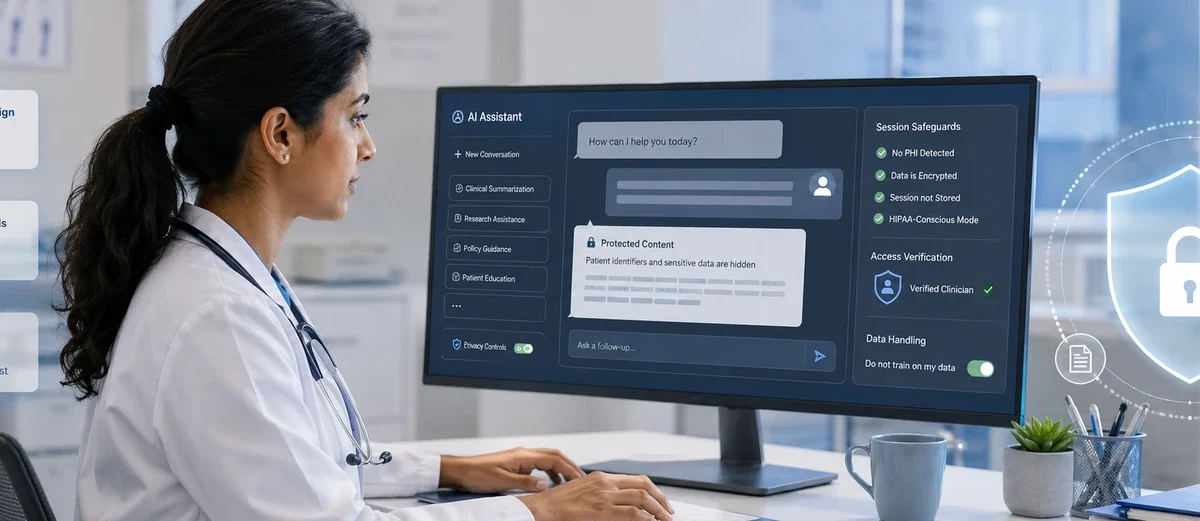
Can Healthcare Professionals Use AI Tools Like ChatGPT Without Violating HIPAA?
Yes… but only under the right circumstances.
Healthcare professionals can use AI tools such as ChatGPT to improve productivity, assist with administrative tasks, brainstorm ideas, draft non-clinical content, and summarize publicly available information. However, entering Protected Health Information (PHI) into public AI tools without appropriate safeguards may create privacy, security, contractual, and regulatory concerns. Every healthcare organization should establish clear AI governance policies, educate employees, and evaluate AI platforms before incorporating them into clinical or business workflows.
Who This Guide Is For
This guide is designed for:
- Physicians
- Dentists
- Nurse Practitioners
- Practice Administrators
- Office Managers
- Compliance Officers
- Healthcare Executives
- IT Managers
- Medical Billing Teams
- Behavioral Health Providers
- Home Health Agencies
If your organization is exploring ChatGPT, Microsoft Copilot, Google Gemini, or other AI platforms, this guide will help you understand how to adopt AI responsibly while protecting patient privacy and supporting HIPAA compliance.
Artificial Intelligence Has Arrived in Healthcare
Artificial Intelligence is no longer a future technology.
It’s already being used in healthcare organizations every day.
Employees may be using AI to:
- Draft emails
- Create patient education materials
- Summarize meeting notes
- Write marketing content
- Generate job descriptions
- Create training documentation
- Translate non-clinical content
- Organize research
- Improve administrative workflows
In many cases, employees begin experimenting with AI before leadership has formally approved its use.
That creates a challenge.
Healthcare organizations want to encourage innovation while protecting patient privacy, maintaining regulatory compliance, and reducing cybersecurity risk.
The question is no longer:
“Should we use AI?”
Instead, healthcare leaders are asking:
“How do we use AI safely?”
Why This Matters to Your Practice
Artificial Intelligence has the potential to improve efficiency, reduce administrative workloads, and support better business operations. Without clear governance, however, well-intentioned employees may inadvertently expose sensitive information or create unnecessary compliance risks.
The Biggest Misunderstanding About ChatGPT and HIPAA
One of the most common misconceptions is that ChatGPT itself is either “HIPAA compliant” or “not HIPAA compliant.”
The reality is more nuanced.
HIPAA applies to how healthcare organizations collect, use, disclose, and protect Protected Health Information (PHI).
Whether an AI tool can be used appropriately depends on several factors, including:
- How the AI platform processes data
- Whether patient information is entered
- Contractual agreements with the AI provider
- Organizational policies
- Security controls
- Employee training
- Intended use
In other words, the question is not simply whether an AI application supports healthcare.
The more important question is:
How is your organization using it?
What Is Protected Health Information (PHI)?
Before using any AI tool, employees should understand what qualifies as Protected Health Information.
PHI includes individually identifiable information related to a person’s:
- Health condition
- Medical treatment
- Payment for healthcare services
Examples include:
- Patient names
- Dates of birth
- Medical record numbers
- Insurance identification numbers
- Email addresses
- Telephone numbers
- Physical addresses
- Appointment details
- Laboratory results
- Clinical notes
- Diagnostic images
- Billing records
Even information that appears harmless may become PHI when combined with other identifying details.
For example:
“Mary Smith has diabetes.”
Clearly contains PHI.
But, so might:
“The 42-year-old dentist seen yesterday for hypertension.”
Depending on the circumstances, enough contextual information may exist to identify the individual.
Healthcare professionals should avoid assuming that removing a patient’s name alone makes information safe to share.
Expert Tip
When evaluating whether information is safe to enter into an AI tool, ask yourself: “Could someone reasonably identify this patient from the information I’m providing?” If the answer is “possibly,” the information should be treated as Protected Health Information.
Can Healthcare Employees Use ChatGPT?
Yes. However, the answer depends entirely on what they’re asking it to do.
Many administrative tasks can be performed safely without involving patient information.
For example, employees may use AI to:
- Draft internal announcements
- Improve business writing
- Create training outlines
- Brainstorm marketing ideas
- Develop patient education templates
- Create policy drafts
- Write job postings
- Organize project plans
- Summarize publicly available regulations
These activities generally do not require entering Protected Health Information.
The situation changes when employees begin entering patient-specific information into public AI platforms.
Without appropriate safeguards and organizational approval, this can create significant privacy and compliance concerns.
Safe Uses of AI in a Medical Practice
Healthcare organizations are discovering many ways AI can improve efficiency while protecting patient privacy.
Examples include:
Administrative Writing
AI can help draft:
- Employee communications
- Meeting agendas
- Policies
- Procedure manuals
- Marketing content
- Newsletter articles
Human review should always occur before publication.
Patient Education Materials
AI can help simplify complex medical concepts into language patients better understand.
Examples include:
- Preparing after-care instructions
- Explaining common medical conditions
- Developing wellness education
- Creating preventive care resources
These materials should always be reviewed by qualified healthcare professionals before distribution.
Operational Planning
Practice administrators may use AI to assist with:
- Workflow improvement
- Process documentation
- Strategic planning
- Technology evaluations
- Project management
- Meeting summaries
Again, these uses generally do not require entering patient-specific information.
Research Assistance
AI can help organize publicly available information, summarize industry publications, compare technology options, and explain technical concepts.
It should not replace professional judgment, clinical expertise, or legal advice.
AI Is an Assistant and NOT a Decision Maker
Perhaps the most important principle healthcare organizations should adopt is this:
AI should support professionals, not replace them.
Artificial Intelligence can accelerate routine work.
It cannot replace:
- Clinical judgment
- Medical decision-making
- Regulatory interpretation
- Professional ethics
- Human accountability
Healthcare providers remain responsible for every decision affecting patient care, regardless of whether AI assisted with part of the process.
Where Healthcare Organizations Get AI Wrong
Artificial Intelligence is incredibly powerful.
Unfortunately, many of the biggest risks don’t come from the technology itself. They come from how people use it.
In many organizations, employees begin experimenting with AI tools before leadership has established policies, approved platforms, or provided training.
This creates inconsistent practices across departments.
One employee may avoid entering patient information altogether.
Another may unknowingly paste clinical notes into a public AI chatbot.
Without governance, employees are left to make their own decisions.
That’s a risk no healthcare organization should accept.
Mistake #1: Entering Protected Health Information Into Public AI Tools
This is the most common concern surrounding AI adoption in healthcare.
Imagine an employee copies a patient’s progress note into a public AI chatbot and asks:
“Rewrite this to sound more professional.”
Although the intent may be harmless, the information entered could contain:
- Patient names
- Medical record numbers
- Appointment dates
- Diagnoses
- Insurance information
- Provider names
- Contact information
Once that information leaves your controlled environment, your organization may lose visibility into how it is stored, processed, or retained.
Healthcare organizations should establish clear expectations regarding what information may and may not be entered into AI systems.
Why This Matters to Your Practice
Employees often use AI because they’re trying to work more efficiently and not because they’re trying to bypass security. Clear guidance helps staff innovate safely while protecting patient privacy.
Mistake #2: Assuming “Anonymous” Means Safe
Many employees believe deleting a patient’s name is enough.
Unfortunately, healthcare information can often be identifiable even without obvious identifiers.
For example:
Instead of writing:
“John Smith was diagnosed with diabetes.”
Someone might write:
“A 53-year-old orthopedic surgeon seen yesterday after knee replacement developed postoperative complications.”
Depending on the circumstances, that information may still be identifiable.
Healthcare organizations should be cautious whenever information relates to an identifiable individual even if names have been removed.
De-identification is more complex than simply deleting obvious identifiers.
Mistake #3: Using AI for Clinical Decision-Making Without Review
AI can organize information remarkably well.
It should not replace licensed healthcare professionals.
Examples of inappropriate reliance include:
- Accepting AI-generated diagnoses without verification
- Copying treatment recommendations directly into patient records
- Using AI as the sole source for medication decisions
- Relying on AI interpretations without clinical review
Healthcare professionals remain responsible for all clinical decisions.
AI should function as an assistant and not an autonomous clinician.
Mistake #4: Assuming AI Is Always Correct
Large Language Models can occasionally produce inaccurate or fabricated information.
This phenomenon is sometimes called a “hallucination.”
Examples include:
- Incorrect regulatory citations
- Outdated medical recommendations
- Invented references
- Inaccurate technical guidance
- Misinterpreted healthcare regulations
For this reason, AI-generated content should always be reviewed by qualified personnel before being used for:
- Patient education
- Internal policies
- Public communications
- Compliance documentation
- Technology decisions
Verification remains essential.
Mistake #5: Allowing Unapproved AI Applications
Employees often discover new AI tools before IT departments do.
Without governance, organizations may unknowingly accumulate dozens of AI applications across departments.
This is sometimes referred to as Shadow AI.
Examples include:
- Browser extensions
- AI transcription services
- Writing assistants
- Meeting summarization tools
- AI-powered note-taking applications
- Document analysis platforms
Every additional AI application may introduce:
- Privacy concerns
- Security risks
- Licensing issues
- Data retention questions
- Vendor management challenges
Organizations should establish an approval process before employees adopt new AI tools.
Expert Tip
Shadow AI is becoming as significant a governance challenge as Shadow IT was over the past decade. Healthcare organizations should inventory approved AI tools and provide employees with secure alternatives rather than relying solely on prohibitions.
Is De-Identified Information Always Safe?
Healthcare professionals frequently ask:
“If I remove the patient’s name, can I use AI?”
The answer depends on whether the information has been properly de-identified and whether organizational policies permit that use.
Simply removing one identifier may not eliminate the possibility that someone could identify the individual when other details are present.
Examples of contextual information include:
- Rare diagnoses
- Small communities
- Dates of treatment
- Occupations
- Family relationships
- Geographic locations
- Unique clinical circumstances
Healthcare organizations should avoid relying on individual employees to make complex de-identification decisions without appropriate guidance.
When in doubt, don’t enter the information.
Public AI vs. Enterprise AI
Not all AI platforms operate under the same security, privacy, or contractual models.
Healthcare leaders should understand the difference between publicly available AI services and enterprise-grade AI solutions before approving their use.
Public AI Platforms
Many publicly accessible AI tools are designed for general-purpose use.
Depending on the service and configuration, organizations may have limited visibility into:
- Data handling practices
- Retention policies
- Administrative controls
- User management
- Audit capabilities
- Enterprise governance
These platforms may be perfectly appropriate for many non-sensitive business tasks, but they should be evaluated carefully before being incorporated into healthcare workflows.
Enterprise AI Solutions
Enterprise-focused AI offerings often provide additional capabilities designed for organizational use, such as:
- Centralized administration
- Identity management integration
- Access controls
- Audit logging
- Data governance options
- Security configurations
- Organizational policy controls
The specific features vary by vendor and licensing model, so healthcare organizations should review documentation carefully and evaluate each platform based on their operational, security, and compliance requirements.
Why This Matters to Your Practice
Choosing an AI platform isn’t simply a technology decision. It’s also a governance, privacy, security, and operational decision that should involve IT, compliance, and leadership.
Building an AI Governance Program
Successful AI adoption begins long before employees start using AI tools.
Healthcare organizations should establish a governance framework that balances innovation with responsible risk management.
A practical AI governance program typically includes the following components.
Step 1: Define Organizational Objectives
Begin by asking:
- Why are we adopting AI?
- Which business problems are we trying to solve?
- Which departments will benefit most?
- What outcomes are we trying to improve?
Technology should support organizational goals and not become an end in itself.
Step 2: Approve AI Platforms
Rather than allowing employees to choose any AI application they find online, establish an approval process that evaluates:
- Vendor reputation
- Security capabilities
- Privacy practices
- Administrative controls
- Integration options
- Licensing requirements
- Organizational fit
Providing approved tools encourages innovation while reducing unnecessary risk.
Step 3: Create an AI Usage Policy
Every healthcare organization should establish clear expectations regarding:
- Acceptable uses
- Prohibited uses
- Protection of patient information
- Human review requirements
- Documentation standards
- Data handling practices
- Employee responsibilities
Policies should be written in plain language that employees can easily understand and apply.
Step 4: Train Your Workforce
Technology policies are only effective when employees understand them.
Training should include:
- Real-world examples
- Practical scenarios
- Common mistakes
- Reporting procedures
- Approved AI tools
- Privacy expectations
Employees should feel confident asking questions rather than guessing how AI should be used.
AI Governance Checklist for Healthcare Organizations
Artificial Intelligence is evolving rapidly.
Healthcare organizations don’t need to adopt every new AI capability immediately but they do need a structured approach for evaluating and governing AI as it becomes part of everyday operations.
Use the following checklist to assess your organization’s AI readiness.
Leadership & Governance
- Executive leadership has discussed AI adoption.
- Organizational goals for AI have been defined.
- An individual or committee oversees AI governance.
- AI risks are reviewed alongside other technology risks.
- AI initiatives align with organizational strategy.
- Leadership receives periodic updates on AI usage.
Successful AI adoption begins with governance and not with technology.
AI Usage Policy
- A written AI Usage Policy has been approved.
- Employees understand acceptable uses of AI.
- Prohibited uses are clearly documented.
- Human review requirements are defined.
- Employees know how to request approval for new AI tools.
- AI policies are reviewed regularly.
Policies establish expectations before inconsistent practices become common.
Privacy & Patient Information
- Employees understand what constitutes Protected Health Information (PHI).
- Staff know when PHI should never be entered into unauthorized AI platforms.
- Privacy expectations have been incorporated into AI training.
- AI workflows are reviewed for privacy risks.
- Data handling expectations are documented.
- Compliance leadership participates in AI governance discussions.
Protecting patient privacy should remain a foundational principle regardless of how AI technology evolves.
Why This Matters to Your Practice
AI adoption should never require compromising patient trust. Strong governance enables organizations to benefit from AI while maintaining the privacy, confidentiality, and professionalism patients expect from their healthcare providers.
Security
- Approved AI platforms are documented.
- AI applications integrate with organizational identity management where appropriate.
- Multi-Factor Authentication is enabled when available.
- Access to enterprise AI platforms is reviewed periodically.
- AI vendors undergo appropriate security evaluations.
- AI-related cybersecurity risks are incorporated into security planning.
AI should become part of your broader cybersecurity program and not operate outside it.
Workforce Education
- Employees receive AI awareness training.
- Staff understand the difference between public AI and approved enterprise AI tools.
- Practical AI scenarios are included in employee education.
- Managers reinforce AI expectations during team meetings.
- Employees know where to ask AI-related questions.
- AI guidance is updated as technology changes.
Organizations that invest in workforce education are better positioned to adopt AI responsibly than those relying solely on restrictive policies.
Clinical Governance
- Clinical leadership participates in AI governance decisions.
- AI outputs are reviewed before influencing patient care.
- Clinical decision-making remains the responsibility of licensed professionals.
- AI-generated educational materials undergo clinical review.
- Documentation standards include AI-assisted content where appropriate.
- Employees understand AI’s limitations.
Healthcare professionals, not AI systems, remain accountable for clinical decisions.
Vendor Management
- AI vendors are evaluated before organizational adoption.
- Contracts are reviewed by appropriate stakeholders.
- Security documentation is evaluated.
- Privacy practices are reviewed.
- Vendor responsibilities are clearly understood.
- AI platforms are reassessed periodically.
Healthcare organizations should evaluate AI vendors with the same diligence applied to other technology providers.
Monitoring & Continuous Improvement
- AI policies are reviewed annually.
- New AI tools are evaluated before adoption.
- Employee feedback is incorporated into governance.
- AI-related incidents are documented and reviewed.
- Organizational AI maturity is periodically assessed.
- Leadership adjusts governance as technology evolves.
AI governance is not a one-time initiative.
It should mature alongside your organization.
Assessing Your AI Readiness
After completing the checklist, consider where your organization currently stands.
Emerging
Your organization is beginning to explore AI but has not yet established formal governance.
Common priorities include:
- Understanding AI capabilities
- Developing an AI Usage Policy
- Identifying approved use cases
- Beginning employee education
Developing
Your organization has started implementing AI governance.
Characteristics often include:
- Written AI policies
- Leadership involvement
- Approved AI platforms
- Workforce education
- Initial privacy reviews
The next step is integrating AI governance into broader cybersecurity, compliance, and operational planning.
Mature
AI governance has become part of everyday organizational operations.
Typical characteristics include:
- Executive oversight
- Cross-functional governance
- Ongoing workforce education
- Vendor evaluation processes
- Continuous policy improvement
- Strong privacy controls
- Clinical oversight
- Regular governance reviews
Organizations at this stage typically focus less on whether AI should be used and more on how to maximize its value responsibly.
Expert Tip
AI governance should be viewed as a continuous improvement process. As regulations, technologies, and organizational priorities evolve, your governance framework should evolve with them.
Practical AI Use Cases for Healthcare Organizations
Many healthcare leaders ask:
“If we can’t use AI with patient information, where can it actually help?”
The answer is: in many areas of healthcare operations.
Examples include:
Administrative Efficiency
- Drafting internal communications
- Creating meeting agendas
- Preparing employee training materials
- Developing policies and procedures
- Summarizing operational meetings
Marketing & Patient Engagement
- Writing blog articles
- Creating social media content
- Developing website copy
- Producing newsletters
- Creating educational resources
Human review remains essential before publication.
Practice Management
- Workflow documentation
- Process improvement brainstorming
- Strategic planning
- Project management assistance
- Vendor comparisons
- Technology evaluations
Education
AI can assist with:
- Staff training outlines
- Frequently Asked Questions
- Educational presentations
- Technical explanations
- Simplifying complex concepts
Healthcare professionals should always review AI-generated educational content for accuracy and appropriateness.
AI Is Changing Healthcare Leadership
Artificial Intelligence isn’t replacing healthcare professionals.
It’s changing how healthcare leaders think about productivity.
Organizations that adopt AI responsibly may be able to:
- Reduce administrative burdens
- Improve operational efficiency
- Accelerate document creation
- Enhance workforce productivity
- Support better knowledge sharing
The greatest competitive advantage may not come from using the most AI tools.
It may come from building the strongest governance around them.
Why This Matters to Your Practice
Responsible AI adoption isn’t about moving the fastest. It’s about creating an environment where innovation, patient privacy, cybersecurity, and professional accountability can coexist.
Executive Summary for Healthcare Leaders
If you only remember five things from this guide, remember these:
1. AI Can Improve Healthcare Operations
Artificial Intelligence has tremendous potential to improve productivity, reduce administrative burdens, and support better organizational efficiency.
2. Governance Is More Important Than the Technology
The greatest AI risks usually arise from unclear expectations and not from the technology itself.
Organizations that establish policies, training, and oversight are better positioned to adopt AI responsibly.
3. Patient Privacy Must Remain the Priority
Healthcare organizations should carefully evaluate how AI tools are used and ensure employees understand how to protect Protected Health Information.
Trust remains one of healthcare’s most valuable assets.
4. AI Supports Professionals and It Doesn’t Replace Them
Healthcare professionals remain responsible for clinical decisions, documentation, patient communication, and regulatory compliance.
AI should enhance professional expertise rather than replace it.
5. Responsible AI Adoption Creates Competitive Advantage
Healthcare organizations that thoughtfully integrate AI into administrative and operational workflows may improve efficiency while maintaining strong governance, cybersecurity, and patient trust.
How Fothion Helps Healthcare Organizations Adopt AI Responsibly
Artificial Intelligence presents exciting opportunities but successful adoption requires more than selecting the right technology.
Healthcare organizations need a governance framework that balances innovation, cybersecurity, operational efficiency, and patient privacy.
At Fothion, we help healthcare organizations evaluate and implement AI responsibly by combining healthcare-focused IT expertise with practical governance guidance.
Our services include:
- AI readiness assessments
- AI governance strategy
- Technology policy development
- Healthcare cybersecurity consulting
- Microsoft 365 security and Copilot readiness
- Identity and access management
- HIPAA Security Risk Assessments
- Workforce cybersecurity and AI awareness training
- Managed IT Services
- Strategic technology planning
Our objective isn’t simply to introduce new technology.
It’s to help healthcare organizations adopt innovation in a way that supports clinical operations, protects patient information, and aligns with long-term business goals.
Schedule a Healthcare Technology Governance Review
Schedule an AI Readiness Assessment
If your healthcare organization is considering AI or if employees are already experimenting with AI tools, it may be time to evaluate your readiness.
An AI Readiness Assessment can help your organization:
- Identify appropriate AI use cases
- Evaluate governance gaps
- Develop an AI Usage Policy
- Improve workforce education
- Reduce privacy and cybersecurity risks
- Align AI initiatives with business objectives
Responsible AI adoption starts with understanding both the opportunities and the risks.
Book your 30-minute call with Fothion now:

Continue Learning About Healthcare IT & Cybersecurity
Technology governance is just one element of a resilient healthcare IT strategy.
Continue exploring our Industry Insights on Healthcare IT:
- HIPAA Compliance for Medical Practices: What Every Healthcare Organization Needs to Know
- Ransomware Attacks on Medical Practices: What Happens, How to Respond, and How to Protect Your Patients
- How to Create Secure Technology Policies for Your Medical or Dental Practice
- Healthcare Cybersecurity Checklist: Essential Security Controls Every Practice Should Have
- How to Choose the Right Managed IT Provider for Your Medical or Dental Practice
- Microsoft 365 Security Best Practices for Healthcare Organizations
Together, these resources help healthcare leaders navigate technology decisions with confidence while supporting cybersecurity, compliance, operational excellence, and exceptional patient care.
About This Guide
This guide is part of the Fothion’s Industry Insights, a growing collection of educational resources designed to help healthcare organizations understand complex technology topics through practical, actionable guidance.
Rather than focusing on fear or technical jargon, our goal is to help healthcare leaders make informed decisions that strengthen their organizations today while preparing for tomorrow’s opportunities.
As AI continues to evolve, organizations that combine thoughtful governance with responsible innovation will be best positioned to improve operational efficiency while maintaining the trust their patients place in them.
Educational Disclaimer
This article is provided for general educational and informational purposes only and should not be considered legal, regulatory, or compliance advice. Every healthcare organization has unique operational, contractual, and regulatory requirements that may affect how technology, cybersecurity, Artificial Intelligence (AI), and HIPAA obligations apply.
Healthcare organizations should consult qualified legal counsel, compliance professionals, and trusted technology advisors when making decisions regarding HIPAA compliance, AI governance, cybersecurity, privacy, or regulatory obligations.
The information in this guide reflects generally accepted industry practices and the regulatory landscape at the time of publication. Because technology, cybersecurity threats, and applicable regulations continue to evolve, organizations should periodically review their policies, procedures, and governance practices.
Final Thoughts
Artificial Intelligence represents one of the most significant technology shifts healthcare has experienced in decades.
The organizations that benefit most won’t necessarily be those that adopt AI first.
They’ll be the ones that adopt it thoughtfully.
Responsible AI adoption requires more than powerful software. It requires leadership, governance, workforce education, cybersecurity, and a commitment to protecting patient trust.
Healthcare has always balanced innovation with responsibility.
Artificial Intelligence is no different.
By establishing clear policies, selecting appropriate technologies, educating employees, and maintaining strong oversight, healthcare organizations can confidently embrace AI while preserving the privacy, professionalism, and quality of care their patients expect.
Innovation and compliance are not competing priorities.
With the right governance framework, they can work together to strengthen the future of healthcare.
Frequently Asked Questions About AI, ChatGPT, and HIPAA
Healthcare leaders are asking more questions about Artificial Intelligence than almost any other emerging technology.
Below are practical answers to the questions we hear most often from physicians, practice administrators, compliance officers, and healthcare executives.
Can Healthcare Professionals Use ChatGPT at Work?
Yes… in many situations.
Healthcare professionals can safely use AI tools for a variety of administrative and business functions, including:
- Drafting emails
- Creating meeting agendas
- Developing policies and procedures
- Writing marketing content
- Creating patient education templates
- Brainstorming operational improvements
- Summarizing publicly available information
The key consideration is what information is being shared.
Organizations should establish clear guidance regarding approved uses and ensure employees understand when patient information should never be entered into AI systems.
Is ChatGPT HIPAA Compliant?
This question doesn’t have a simple yes-or-no answer.
HIPAA is a federal regulation that governs how covered entities and business associates protect Protected Health Information (PHI).
Whether an AI platform can be used appropriately depends on several factors, including:
- The intended use
- The information entered into the platform
- The organization’s governance policies
- Security configurations
- Contractual agreements
- Workforce training
- Applicable regulatory requirements
Rather than asking whether an AI tool is “HIPAA compliant,” healthcare organizations should evaluate whether their specific implementation aligns with their privacy, security, legal, and operational responsibilities.
Can I Remove the Patient’s Name and Use AI?
Not necessarily.
Simply removing a patient’s name may not sufficiently de-identify information.
Other details such as age, diagnosis, treatment dates, geographic location, occupation, or uncommon medical conditions, may still allow someone to identify the individual.
Healthcare organizations should establish clear guidance on what information may be used with AI tools and avoid relying on employees to make complex de-identification decisions independently.
Can AI Write Clinical Documentation?
AI technology continues to evolve rapidly, and many healthcare organizations are exploring AI-assisted documentation.
However, regardless of how documentation is created, healthcare professionals remain responsible for ensuring that:
- Information is accurate
- Documentation reflects the actual patient encounter
- Clinical judgment is exercised
- Regulatory and organizational requirements are met
AI should assist documentation and not replace professional accountability.
Can AI Replace Healthcare Professionals?
No.
Artificial Intelligence can improve efficiency, automate repetitive tasks, and organize information.
It cannot replace:
- Clinical judgment
- Professional ethics
- Patient relationships
- Critical thinking
- Human empathy
- Accountability for patient care
Healthcare decisions should always remain under the supervision of qualified professionals.
Should Every Healthcare Organization Have an AI Usage Policy?
Yes.
Even organizations that have not formally adopted AI may discover that employees are already using publicly available tools.
An AI Usage Policy helps establish:
- Approved AI platforms
- Acceptable uses
- Privacy expectations
- Human review requirements
- Employee responsibilities
- Approval processes for new AI technologies
Clear expectations help employees innovate responsibly while reducing unnecessary organizational risk.
How Often Should AI Policies Be Updated?
Because AI technology is evolving quickly, organizations should review AI governance at least annually.
Additional reviews should occur when:
- New AI capabilities are introduced
- New platforms are adopted
- Regulatory guidance changes
- Organizational priorities evolve
- Significant security or privacy events occur
AI governance should remain flexible enough to adapt to changing technologies and business needs.
Leave a Comment