
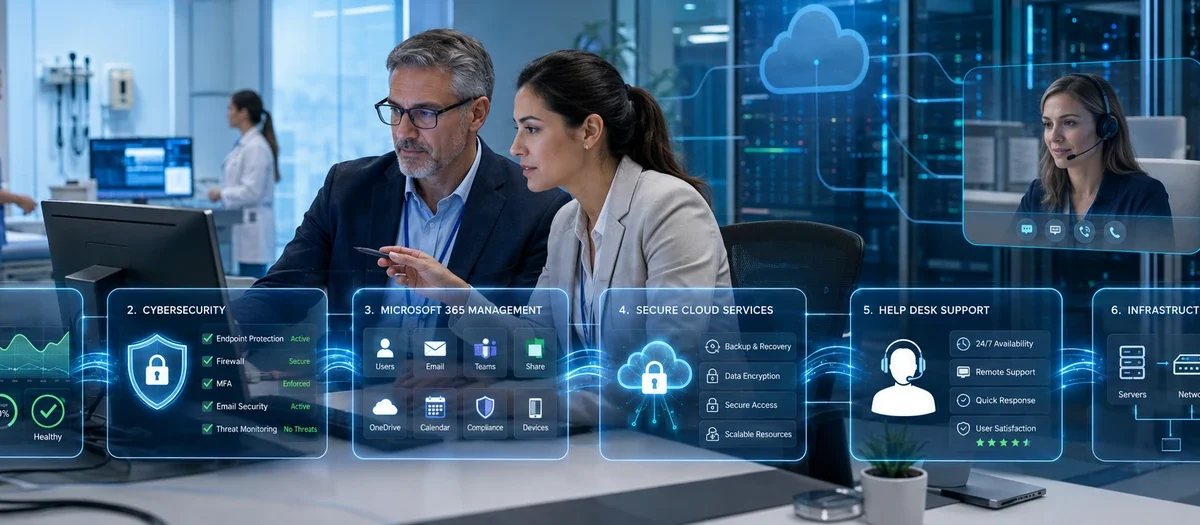
What Does Managed IT Services Include for a Medical Practice
Managed IT Services provide healthcare organizations with proactive technology management rather than reactive computer repair. While services vary by provider, a comprehensive healthcare-focused Managed IT program typically includes 24/7 monitoring, help desk support, cybersecurity, Microsoft 365 management, backup and disaster recovery, vendor coordination, technology lifecycle planning, and strategic IT consulting. The goal isn’t simply to fix problems; it’s to reduce downtime, strengthen security, improve operational efficiency, and help healthcare organizations use technology to better support patient care.
Who This Guide Is For
This guide is designed for:
- Physicians
- Medical Practice Owners
- Dental Practice Owners
- Practice Administrators
- Office Managers
- Healthcare CEOs
- Executive Directors
- Operations Managers
- Compliance Officers
Whether you’re evaluating your first outsourced IT provider or replacing your current technology partner, this guide will help you make a more informed decision.
What Are Managed IT Services?
The phrase “Managed IT Services” is used frequently throughout the technology industry.
Unfortunately, it doesn’t always mean the same thing.
Some providers primarily offer remote technical support, while others focus heavily on cybersecurity.
Some simply monitor computers. Others function as outsourced IT departments and strategic advisors.
For healthcare organizations, Managed IT Services should encompass far more than troubleshooting technical issues. They should provide continuous support for the technology that enables physicians, clinical staff, and administrators to deliver safe, efficient patient care.
Why This Matters to Your Practice
If your definition of IT support is “someone to call when something breaks,” you’re likely missing much of the value a modern Managed IT provider can deliver. The best providers spend more time preventing problems than fixing them.
Managed IT Is Proactive, Not Reactive
Traditional computer support often follows a break-fix model.
Something fails, the healthcare institution calls IT.
The technician repairs the problem.
Everyone returns to work.
While this approach may solve immediate issues, it doesn’t necessarily reduce future risk or improve long-term reliability.
Managed IT Services take a different approach.
Rather than waiting for failures, providers continuously monitor systems, apply updates, identify potential issues, and recommend improvements before problems disrupt patient care.
The objective is to reduce:
- Unexpected downtime
- Cybersecurity risk
- Equipment failures
- Productivity loss
- Technology-related frustration
Preventive maintenance generally costs less and causes less disruption than emergency recovery.
Expert Tip
Ask prospective IT providers how much of their work is proactive versus reactive. Their answer can provide valuable insight into how they approach technology management and client success.
Why Healthcare Organizations Need More Than Basic IT Support
Healthcare technology environments have become significantly more complex.
Today’s medical practices rely on interconnected systems that must work reliably every day.
Examples include:
- Electronic Health Records (EHRs)
- Practice Management software
- Digital imaging
- Microsoft 365
- Cloud applications
- VoIP phone systems
- Telehealth platforms
- Medical devices
- Secure wireless networks
- Cybersecurity tools
Supporting these technologies requires more than occasional troubleshooting.
It requires ongoing planning, monitoring, vendor coordination, cybersecurity, and strategic oversight.
That’s why many healthcare organizations choose Managed IT Services instead of relying solely on internal staff or on-demand technical support.
What’s Typically Included in Managed IT Services?
Although service offerings vary by provider, most healthcare-focused Managed IT agreements include several core components.
Let’s examine each one.
1. Help Desk & Technical Support
The most visible part of Managed IT Services is user support.
Employees need assistance with:
- Password resets
- Printer issues
- Email problems
- Software questions
- Connectivity issues
- Hardware troubleshooting
- New user setup
- Device configuration
A responsive help desk helps employees return to work quickly while minimizing disruptions to patient care.
However, excellent Managed IT providers don’t measure success solely by the number of tickets they close.
They also look for ways to reduce the number of tickets employees need to submit in the first place.
2. 24/7 Monitoring
Modern Managed IT providers continuously monitor technology environments for signs of potential issues.
Monitoring may include:
- Servers
- Workstations
- Cloud services
- Network devices
- Backup jobs
- Storage capacity
- Internet connectivity
- Security alerts
- Hardware health
Continuous monitoring allows many issues to be identified before employees notice them.
This proactive approach often reduces downtime and improves system reliability.
3. Patch Management
Keeping software current is one of the simplest—and most effective—ways to reduce cybersecurity risk.
Managed IT providers typically help organizations maintain:
- Windows updates
- Third-party applications
- Firmware updates
- Security patches
- Driver updates
- Operating system maintenance
Updates should be managed thoughtfully to balance security, stability, and operational continuity.
4. Endpoint Protection
Healthcare organizations should expect cybersecurity to be integrated into Managed IT Services.
Endpoint protection typically includes technologies designed to detect, prevent, and respond to suspicious activity on computers and servers.
Depending on the provider, services may include:
- Endpoint Detection and Response (EDR)
- Managed antivirus
- Threat monitoring
- Device isolation capabilities
- Malware detection
- Security alert management
Protecting endpoints helps reduce the likelihood that a single compromised device affects the broader organization.
Why This Matters to Your Practice
Every workstation used by physicians, nurses, front-office staff, or billing teams represents both a productivity tool and a potential entry point for cybercriminals. Strong endpoint protection helps safeguard both patient information and daily operations.
5. Microsoft 365 Management
For many healthcare organizations, Microsoft 365 has become the central platform for communication, collaboration, document management, and day-to-day business operations.
A healthcare-focused Managed IT provider should help organizations manage and secure Microsoft 365—not simply create user accounts.
Services commonly include:
- User onboarding and offboarding
- License management
- Microsoft Teams administration
- SharePoint guidance
- OneDrive management
- Multi-Factor Authentication (MFA)
- Conditional Access policies
- Identity management
- Security monitoring
- Email security optimization
The goal is to ensure Microsoft 365 remains secure, reliable, and aligned with the organization’s operational needs.
Why This Matters to Your Practice
Microsoft 365 often contains your organization’s email, shared documents, financial information, HR records, and operational communications. Managing it proactively helps reduce cybersecurity risks while improving collaboration across your practice.
6. Backup & Disaster Recovery
Every healthcare organization should prepare for unexpected events.
Examples include:
- Hardware failures
- Ransomware attacks
- Human error
- Internet outages
- Natural disasters
- Cloud service disruptions
Managed IT providers typically help organizations develop backup strategies that support business continuity.
This often includes:
- Automated backups
- Backup monitoring
- Recovery testing
- Disaster Recovery planning
- Recovery documentation
- Backup verification
- Business Continuity guidance
A provider should also help leadership understand:
- Recovery priorities
- Expected recovery timelines
- Critical systems
- Recovery procedures
A backup strategy is only valuable if it has been tested and leadership understands how recovery will occur.
7. Cybersecurity Services
Cybersecurity should not be treated as a separate product purchased only after a security incident.
It should be integrated into everyday IT management.
Healthcare-focused Managed IT providers often support organizations through:
- Endpoint Detection and Response (EDR)
- Security awareness training
- Vulnerability management
- Identity and access management
- Email security
- Security monitoring
- Microsoft 365 security
- Incident Response planning
- Security Risk Assessments
- AI governance guidance
Rather than focusing on individual security products, effective providers help organizations build layered cybersecurity programs that evolve over time.
8. Vendor Coordination
Healthcare organizations rely on numerous technology vendors.
Examples include:
- Electronic Health Record (EHR) vendors
- Dental software providers
- Imaging companies
- Telephone providers
- Internet Service Providers
- Cloud application vendors
- Laboratory integrations
- Medical device manufacturers
- Payment processing providers
When technical issues occur, your Managed IT provider should coordinate with these vendors whenever appropriate.
Instead of requiring your office manager or physician to spend hours navigating technical support calls, your IT partner should help facilitate communication and problem resolution.
Effective vendor coordination reduces delays and allows your staff to remain focused on patient care.
9. Strategic Technology Planning
One of the most valuable aspects of Managed IT Services is often the least visible.
Strategic planning.
Healthcare organizations should expect their IT provider to help answer questions such as:
- Which technology investments should we prioritize?
- Are we prepared for future growth?
- Is our hardware nearing end of life?
- Should we migrate additional workloads to the cloud?
- How should we approach Artificial Intelligence (AI)?
- Are we investing in the right cybersecurity improvements?
- How should technology budgets evolve over the next several years?
Strategic planning transforms technology from an operational expense into a business asset.
Expert Tip
If your IT provider only contacts you when something breaks—or when it’s time to renew a contract—you may be missing the strategic guidance that modern Managed IT Services are intended to provide.
What’s Usually NOT Included in Managed IT Services?
One of the biggest sources of confusion during provider evaluations is assuming every technology service is included in every Managed IT agreement.
That’s rarely the case.
Although every provider structures services differently, organizations should clarify whether items such as the following are included, optional, or billed separately:
- New hardware purchases
- Software licensing
- Internet service
- Major infrastructure projects
- Office relocations
- After-hours project work
- Cabling
- Specialized consulting engagements
- Large-scale cloud migrations
- Third-party software implementation
Understanding these expectations helps avoid misunderstandings later.
A transparent provider should clearly explain what is included—and what falls outside the standard service agreement.
Common Misconceptions About Managed IT Services
Healthcare leaders sometimes evaluate Managed IT Services based on assumptions rather than current industry practices.
Let’s address a few of the most common misconceptions.
Misconception #1: Managed IT Only Fixes Computers
Modern Managed IT Services encompass far more than troubleshooting.
Providers may also support:
- Cybersecurity
- Microsoft 365
- Strategic planning
- Vendor coordination
- Business Continuity
- Cloud technologies
- AI readiness
- Technology budgeting
The role has evolved significantly over the past decade.
Misconception #2: We Don’t Need Managed IT Because We Have Internal IT Staff
Many healthcare organizations combine internal IT personnel with an external Managed IT provider.
This approach can provide:
- Additional expertise
- 24/7 monitoring
- Specialized cybersecurity capabilities
- Strategic consulting
- Vacation coverage
- Access to broader technical resources
Managed IT providers often complement internal teams rather than replace them.
Misconception #3: Managed IT Eliminates Every Technology Problem
No provider can guarantee that technology issues will never occur.
The objective is to:
- Reduce downtime
- Improve reliability
- Strengthen cybersecurity
- Respond more efficiently
- Improve long-term planning
- Support operational resilience
Technology management focuses on continuous improvement—not perfection.
Misconception #4: All Managed IT Providers Offer the Same Services
Service offerings vary considerably.
Some providers focus primarily on technical support.
Others emphasize cybersecurity.
Some specialize in cloud technologies.
Others concentrate on strategic consulting.
Healthcare organizations should evaluate providers based on expertise, healthcare experience, communication, strategic planning, and long-term partnership—not simply a checklist of services.
Why This Matters to Your Practice
Two Managed IT providers may advertise similar services, yet deliver very different experiences. Asking detailed questions about strategy, communication, cybersecurity, and healthcare expertise often reveals differences that aren’t obvious from a proposal alone.
The Difference Between Break-Fix Support and Managed IT
| Break-Fix IT | Managed IT Services |
|---|---|
| Problems are addressed after they occur | Problems are monitored and addressed proactively whenever possible |
| Revenue depends on service calls | Success is measured by system reliability and client outcomes |
| Limited long-term planning | Ongoing strategic technology planning |
| Minimal cybersecurity focus | Cybersecurity integrated into daily operations |
| Reactive maintenance | Preventive maintenance and monitoring |
| Limited executive involvement | Regular leadership discussions and technology roadmaps |
The difference isn’t simply how support is delivered.
It’s how technology is managed over time.
Healthcare organizations benefit when technology becomes predictable, secure, and aligned with long-term operational goals.
Healthcare Managed IT Services Evaluation Checklist
Every Managed IT provider describes its services a little differently.
That’s why comparing providers based solely on marketing materials or pricing can be misleading.
Instead, evaluate whether your current provider—or a prospective partner—delivers the capabilities your healthcare organization needs to improve security, reliability, and long-term technology performance.
Use this checklist as a practical evaluation tool during annual IT reviews or when considering a new technology partner.
Help Desk & End User Support
- Employees receive timely support when technical issues occur.
- Support is available during our organization’s operating hours.
- Critical issues receive appropriate priority.
- New employees are onboarded efficiently.
- User accounts are created and removed promptly.
- Technical recommendations are explained clearly without unnecessary jargon.
- Staff members know how to request support and understand what to expect.
Responsive support helps employees spend less time troubleshooting technology and more time caring for patients.
Proactive Monitoring
- Servers are monitored continuously.
- Workstations are monitored for performance and security issues.
- Backup jobs are monitored automatically.
- Internet connectivity is monitored.
- Storage capacity is reviewed proactively.
- Critical alerts are investigated promptly.
- Preventive maintenance occurs regularly.
Proactive monitoring allows organizations to identify and address many issues before they disrupt daily operations.
Why This Matters to Your Practice
Waiting until physicians or front-office staff report technology problems often means patient care has already been affected. Proactive monitoring helps reduce unexpected interruptions before they become operational issues.
Cybersecurity
- Multi-Factor Authentication (MFA) has been implemented where appropriate.
- Endpoint Detection and Response (EDR) protects supported devices.
- Microsoft 365 security is reviewed regularly.
- Security awareness training is provided.
- Identity and access management follows best practices.
- Security Risk Assessments are recommended periodically.
- Backup and Disaster Recovery strategies are documented.
- Incident Response planning has been discussed.
Cybersecurity should be integrated into everyday IT management—not offered only after a cyber incident.
Microsoft 365 Management
- User accounts are managed consistently.
- Licensing is reviewed periodically.
- Microsoft Teams governance has been discussed.
- SharePoint permissions are reviewed.
- OneDrive policies are documented.
- Conditional Access has been evaluated.
- Security alerts are monitored.
- Identity protection aligns with organizational needs.
Microsoft 365 should be managed as a strategic business platform—not simply an email service.
Backup & Business Continuity
- Backups are monitored automatically.
- Backup restoration is tested periodically.
- Recovery procedures are documented.
- Critical business systems have been prioritized.
- Leadership understands expected recovery timelines.
- Disaster Recovery planning has been reviewed.
- Business Continuity planning has been discussed.
Preparation before an emergency helps organizations recover more confidently when unexpected events occur.
Vendor Management
- Our IT provider coordinates with technology vendors when needed.
- EHR vendors work effectively with our IT provider.
- Internet service issues are managed efficiently.
- Hardware vendors are coordinated appropriately.
- Cloud software vendors are supported.
- Major technology projects are managed collaboratively.
Strong vendor coordination reduces delays and helps prevent communication breakdowns during critical technology issues.
Strategic Technology Planning
- Leadership meets with the IT provider regularly.
- Technology budgeting discussions occur proactively.
- Hardware lifecycle planning is documented.
- Cloud strategy is reviewed.
- Artificial Intelligence (AI) opportunities have been discussed.
- Cybersecurity improvements are prioritized.
- Technology recommendations align with business objectives.
The best Managed IT providers help leadership make informed technology decisions—not simply resolve support tickets.
Communication
- We know who our primary technology advisor is.
- Communication is proactive rather than reactive.
- Technology recommendations are presented clearly.
- Leadership receives regular updates.
- Project expectations are communicated effectively.
- Escalation procedures are clearly defined.
Strong communication builds trust and improves decision-making across the organization.
Expert Tip
Ask yourself this question: “If we never had another support ticket, would our IT provider still create value for our organization?” If the answer is yes, you’re likely working with a strategic technology partner rather than a reactive support provider.
Understanding Your Managed IT Maturity
After completing the checklist, consider where your organization currently falls.
Basic Support
Technology support focuses primarily on fixing user issues.
Characteristics often include:
- Reactive troubleshooting
- Limited monitoring
- Minimal cybersecurity guidance
- Few strategic discussions
- Vendor coordination only when necessary
Organizations at this stage often experience recurring issues and inconsistent technology planning.
Managed
Your provider actively monitors and maintains your environment.
Typical characteristics include:
- Continuous monitoring
- Regular patch management
- Cybersecurity improvements
- Backup oversight
- Vendor coordination
- Better documentation
- Predictable support processes
Technology becomes more reliable and easier to manage.
Strategic Partnership
Technology has become an integral part of organizational planning.
Characteristics often include:
- Executive strategy meetings
- Long-term technology roadmaps
- Business Continuity planning
- Cybersecurity governance
- AI readiness discussions
- Technology budgeting
- Lifecycle planning
- Continuous operational improvement
Organizations at this level use technology as a competitive advantage rather than simply an operational necessity.
Why This Matters to Your Practice
The goal isn’t to purchase more IT services. It’s to build a partnership that helps your organization become more secure, more resilient, and better prepared for future growth.
Measuring the Value of Managed IT Services
Healthcare leaders sometimes ask:
“How do we know if our Managed IT provider is doing a good job?”
Support ticket counts tell only part of the story.
More meaningful indicators include:
- Reduced technology downtime
- Faster issue resolution
- Fewer recurring technical problems
- Improved cybersecurity maturity
- Better employee productivity
- Successful backup recovery testing
- More predictable technology budgeting
- Stronger vendor relationships
- Leadership confidence in technology planning
- Improved operational resilience
The best technology partnerships improve business outcomes—not just technical metrics.
Managed IT Services Should Grow With Your Organization
As your healthcare organization evolves, your technology needs will change.
You may:
- Open additional locations.
- Add new providers.
- Expand telehealth services.
- Adopt new cloud applications.
- Strengthen cybersecurity.
- Introduce Artificial Intelligence (AI).
- Replace aging infrastructure.
- Integrate new healthcare technologies.
A strategic Managed IT provider should help your organization plan for these changes rather than simply reacting after they occur.
Technology planning should evolve alongside your organization’s goals.
Executive Summary for Healthcare Leaders
If you remember only five ideas from this guide, make them these:
1. Managed IT Is About Prevention, Not Just Repair
The most effective IT providers spend more time preventing problems than fixing them.
Proactive monitoring, maintenance, cybersecurity, and planning reduce operational disruptions before they affect patient care.
2. Healthcare Requires Specialized Technology Support
Healthcare organizations rely on complex technology ecosystems that support clinical operations, business processes, cybersecurity, and patient privacy.
An IT partner with healthcare experience is better equipped to understand these unique operational requirements.
3. Cybersecurity Should Be Part of Everyday IT Management
Cybersecurity is no longer a separate project.
It should be integrated into daily technology operations through identity management, Microsoft 365 security, endpoint protection, employee awareness, backups, and continuous monitoring.
4. Strategic Planning Creates Long-Term Value
Technology decisions should support organizational growth—not simply solve today’s problems.
Regular planning helps leadership prioritize investments, improve budgeting, and prepare for future initiatives such as cloud expansion and Artificial Intelligence.
5. The Right IT Partner Becomes an Extension of Your Organization
The strongest Managed IT providers don’t simply answer support requests.
They become trusted advisors who understand your business, communicate proactively, and help leadership make informed technology decisions.
How Fothion Helps Healthcare Organizations
At Fothion, we believe Managed IT Services should deliver measurable business outcomes—not simply technical support.
Our healthcare-focused approach combines proactive technology management, cybersecurity, strategic planning, and responsive support to help physicians, practice administrators, and executive teams focus on delivering exceptional patient care.
Our Managed IT Services include:
- Proactive system monitoring
- Responsive help desk support
- Microsoft 365 administration and security
- Endpoint Detection and Response (EDR)
- Multi-Factor Authentication (MFA)
- Identity and access management
- Backup and Disaster Recovery planning
- Vendor coordination
- Technology lifecycle planning
- Cybersecurity consulting
- Business Continuity planning
- Strategic IT roadmap development
Rather than reacting to technology problems after they occur, we help healthcare organizations reduce risk, improve reliability, and plan confidently for the future.
Schedule a Healthcare IT Strategy Assessment
If you’re evaluating Managed IT Services—or wondering whether your current provider is delivering the strategic value your organization needs—a Healthcare IT Strategy Assessment is a practical place to begin.
A comprehensive assessment can help your organization:
- Review your current technology environment
- Identify cybersecurity risks
- Evaluate Microsoft 365 security
- Assess backup and Business Continuity readiness
- Review infrastructure health
- Prioritize technology investments
- Develop a long-term technology roadmap
- Align IT with organizational objectives
Understanding your current environment provides a stronger foundation for making future technology decisions.
Book your 30-minute call with Fothion now:

Continue Learning About Healthcare IT & Cybersecurity
Continue expanding your healthcare technology knowledge with these related resources:
- How to Choose the Right IT Provider for Your Medical or Dental Practice
- Healthcare Cybersecurity Checklist: Essential Security Controls Every Medical Practice Should Have
- Microsoft 365 Security Best Practices for Healthcare Organizations
- HIPAA Compliance for Medical Practices: What Every Healthcare Organization Needs to Know
- Ransomware Attacks on Medical Practices: What Happens, How to Respond, and How to Protect Your Patients
- Can Healthcare Professionals Use AI Tools Like ChatGPT Without Violating HIPAA?
Together, these Healthcare Industry Insights provide practical guidance to help healthcare leaders strengthen cybersecurity, improve operational resilience, and make informed technology decisions.
About This Guide
This article is part of Fothion’s Industry Insights, a growing collection of educational resources developed specifically for healthcare organizations navigating today’s evolving technology landscape.
Our Healthcare IT content is designed to help physicians, administrators, executives, and practice leaders better understand how technology influences cybersecurity, operational resilience, workforce productivity, compliance efforts, and long-term business success.
Rather than focusing on technical jargon or product marketing, we provide practical, experience-based guidance that supports informed decision-making and sustainable technology planning.
Educational Disclaimer
This article is provided for general educational and informational purposes only and should not be interpreted as legal, regulatory, financial, contractual, or technology consulting advice. Managed IT Service offerings vary by provider, and every healthcare organization has unique operational, technical, security, and business requirements.
Organizations should carefully evaluate service agreements, support models, cybersecurity capabilities, pricing structures, contractual obligations, and strategic alignment before selecting a Managed IT Services provider. Decisions regarding technology strategy should be made in consultation with qualified advisors who understand your organization’s specific goals and operating environment.
Because healthcare technology and cybersecurity continue to evolve, organizations should periodically review their IT strategy and service relationships to ensure they continue to meet current and future needs.
Final Thoughts
Managed IT Services have evolved far beyond outsourced technical support.
For today’s healthcare organizations, they represent a strategic partnership that combines proactive technology management, cybersecurity, cloud expertise, vendor coordination, and long-term planning.
The right provider helps your organization reduce downtime, strengthen security, improve operational efficiency, and prepare for future growth—all while allowing physicians and staff to focus on delivering exceptional patient care.
As technology becomes increasingly central to healthcare operations, choosing a Managed IT partner should be viewed as a long-term business decision rather than a short-term support solution.
Organizations that invest in proactive technology management today are better positioned to adapt to tomorrow’s challenges with confidence, resilience, and a stronger foundation for success.
Leave a Comment